
Dry Coal Beneficiation & Waterless Sorting

Your Mine Has No Water. You Still Need Clean Coal

Traditional wet coal washing is impossible in water-scarce regions, uneconomic for low-calorific ROM coal, and environmentally damaging in areas where discharge is restricted. High-ash Indian coal with difficult washability characteristics needs a different solution entirely.

John Finlay India’s intelligent dry coal beneficiation technology removes ash, pyrite, gangue, and mineral matter from coal without a single liter of water, delivering >90% gangue rejection rates and <2% coal-in-gangue loss across proven deployments in India, China, and water-scarce mining regions globally.
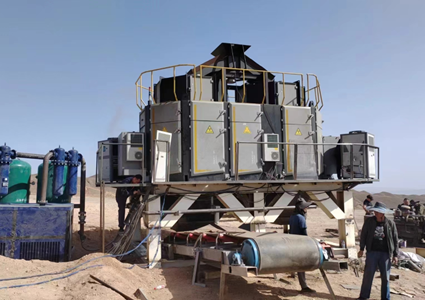
Gangue rejection rate achieved
> 0 %
Coal-in-gangue loss proven in deployment
< 0 %
Liters of process water required
0
mm particle size range processed
10– 280
Dry Coal

Removing Impurities from Coal | Without a Drop of Water

Dry coal beneficiation is the process of removing mineral matter, ash, pyrite, and gangue from run-of-mine coal to improve its calorific value and commercial grade, using sensor-based sorting, X-ray transmission (XRT), and AI-driven intelligence rather than water and magnetite. John Finlay India's dry coal sorting technology uses X-ray transmission to penetrate each coal particle and measure its density and ash content in real time. High-speed air jets then eject reject material with precision, producing a clean coal product, separate gangue, and in advanced applications, extractable minerals such as kaolin from the reject stream. The process is applicable to coarse coal (10 mm–300 mm), is fully waterless, and positions mine operators for Industry 4.0 readiness with AI-driven throughput optimization.

Gangue rejection rate, Xinjiang Zhonglun project (5 Mt/a)
> 40 %
Coal in gangue, verified sorting accuracy across JFI deployments
< 0 %
Single-project dry sorting capacity, Xinjiang, Maomao Mountain
0 Mt/a
Output capability, clean coal, gangue and mineral extraction simultaneously
0 product

Where Conventional Wet Washing Fails Your Mine

When Wet Washing Is Not an Option

The Problem
Water-scarce mining regions Rajasthan, Jharkhand plateau, Xinjiang, where process water supply is unavailable, restricted or prohibitively expensive to source and dispose of
High-ash Indian thermal coal with difficult washability characteristics, where wet processing removes ash but generates unsaleable slurry and tailings disposal obligations
ROM coal with mixed gangue content requiring pre-rejection before wet processing running undifferentiated high-gangue feed through a washery inflates OPEX and destroys magnetite circuits
Zero-liquid-discharge regulatory requirements, where mine discharge consents make wet tailings disposal legally or commercially impossible
Low-calorific coal below economic washability threshold, where the cost of wet processing exceeds the value recovered from marginal-grade feed
Manual picking operations, high dust, safety hazards, labor intensity, and sorting efficiency too low to be viable as a long-term solution

Intelligent Sorting. Zero Water. Proven Results.

JFI's Dry Beneficiation Solution
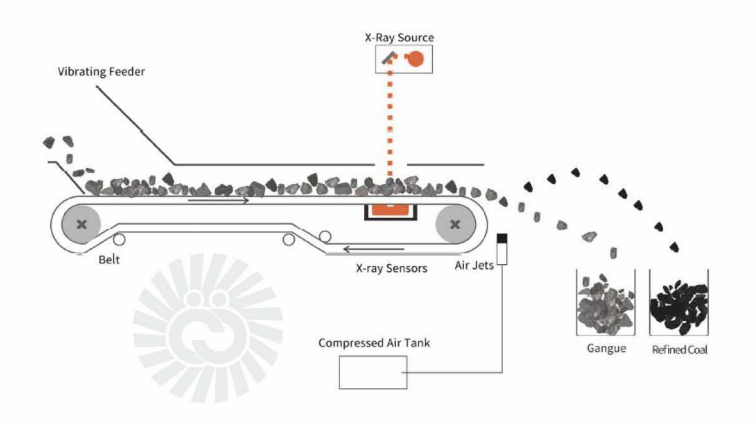
XRT (X-ray Transmission) penetrates each coal particle to measure internal density and ash content, no water required, no surface contamination effects on accuracy
AI-driven sorting algorithm adjusts rejection thresholds dynamically based on feed coal characteristics, consistent product quality even with variable ROM coal grade
Pre-rejection of gangue from 10mm–300mm ROM coal before it enters the wet circuit, reducing wet plant feed volume by 15–40% and cutting OPEX across the whole plant
Zero process water consumption, zero effluent, zero tailings pond, eliminates the full environmental compliance burden of wet processing for the coarse coal fraction
Three-product output: clean coal, gangue pre-rejected, and extractable mineral (kaolin, mineral matter) from the reject stream, creating additional revenue streams from waste
Fully automated, minimal labour, low dust with enclosed processing DGMS compliant, safer than manual picking, and operable remotely
What John Finlay India Dry Coal Beneficiation Covers

What John Finlay India Dry Coal Beneficiation Covers

John Finlay India's offers the full spectrum of dry coal beneficiation technologies from pre-rejection of coarse gangue through AI-driven fine coal sorting to integrated mineral extraction from reject streams.


XRT Intelligent Dry Sorting

X-ray Transmission scanning measures the internal density and mineral content of each coal particle in real time. High-pressure air jets eject reject material at belt speed, sorting coarse coal (10mm–300mm) with >90% gangue rejection and <2% coal loss.

Circle Series Rotary Dry Sorting

High-throughput circular motion dry sorting for small coal particles (25mm–300mm). The FHG-3400-T Circle Series delivers 150–200 t/h per machine, ideal for pre-rejecting gangue from run-of-mine coal before it enters the wet processing circuit.

Sensor-Based Dry Sorting | Insight Series

Multi-sensor sorting combining optical, near-infrared, and XRT detection for fine coal fractions (25mm–50mm). The FHG-SC2400 Insight Series delivers >90 t/h per machine, applied to small-particle coal and secondary mineral extraction from reject streams.

Kaolin & Mineral Extraction from Gangue

John Finlay India's advanced dry sorting systems can separate extractable minerals kaolin, mineral matter from the gangue reject stream as a simultaneous output. Proven at Maomao Mountain Coal Mine, Shanxi Province, converting waste gangue into a commercial mineral product.

Wet Circuit Pre-Rejection Integration

John Finlay India configures dry beneficiation as a pre-treatment stage ahead of conventional wet washing, removing 15–40% of ROM coal volume as gangue before it reaches the washery. This reduces wet plant feed, cuts magnetite consumption, and lowers OPEX across the full plant.

DGMS Compliance & Environmental Approvals

Dry beneficiation eliminates tailings pond, effluent treatment, and water-discharge consent requirements entirely. John Finlay India provides DGMS-compliant plant layouts, EIA-aligned environmental baseline documentation, and regulatory submission packages for all dry sorting installations.

Purpose Built Machines for Every Particle Size and Throughput Requirement

John Finlay India supplies, installs and commissions the full Golden Coal dry sorting machine range, matched to your ROM coal particle size distribution, throughput target, and site conditions.


XRT Intelligent Dry Coal Sorting Machine | Coarse Coal

Primary coarse coal sorting for 50mm–300mm ROM coal, three-product output including clean coal, gangue, and mineral separation
The FHG-2800-X uses X-ray Transmission (XRT) technology to penetrate and measure the internal density and ash content of each coal particle passing across the sorting belt. The AI-driven sorting algorithm classifies each particle in real time, triggering high-pressure air jets to precisely eject gangue and mineral reject into separate collection chutes — leaving clean coal product on the belt. Deployed at Maomao Mountain Coal Mine, Shanxi Province, processing 5 Mt/a of 1/3 coking coal with high gangue and kaolinite content.
XRT penetration, measures internal particle density, unaffected by surface dust or moisture
Three-product output: clean coal, gangue, extractable mineral (kaolin)
Zero water consumption, fully waterless operation
AI algorithm classifies and rejects each individual particle at belt speed
High-pressure air jet rejection — precise, high-speed, fully automated
Remote monitoring and AI algorithm optimization included
FHG-2800-X Golden Coal Series

Circle Series High-Throughput Dry Sorting Machine | Small Coal

High-capacity rotary dry sorting for 25mm–300mm small coal fractions and ROM coal pre-rejection ahead of wet processing circuits
The FHG-3400-T Circle Series delivers high-throughput dry sorting for the 25 mm–300 mm coal fraction, the most common ROM coal particle size range at Indian and Chinese mine-mouth washeries. Deployed at both Xinjiang Zhonglun (5 Mt/a, water-scarce desert operation) and Maomao Mountain (10 Mt/a expansion), it handles high-gangue feed coal and delivers deep pre-rejection of reject material before the ROM coal enters the wet processing circuit, reducing washery feed volume and OPEX significantly. Ideal for operations that use dry sorting as a pre-treatment stage.
High-throughput rotary design 150–200 t/h per unit for large-scale ROM pre-rejection
Waterless ideal for Rajasthan, Jharkhand, Xinjiang and all water-scarce mine locations
Handles high-gangue feed coal with variable ROM quality, AI algorithm adjusts dynamically
Proven in water-scarce desert operation, Xinjiang, Turpan, annual rainfall <20mm
Multiple units scalable in parallel for large ROM throughput requirements
FHG-3400-T Circle Series

Kaolin & Mineral Extraction Sorting Machine

Secondary sorting of gangue reject stream for mineral extraction; kaolin, mineral matter, converting reject waste into commercial mineral product
The FHG-1600-C processes the gangue reject stream from primary dry coal sorting, separating extractable kaolin and mineral matter from the waste rock and creating a commercial mineral by-product. Deployed at Maomao Mountain Coal Mine where coal seams contain significant kaolinite content, the FHG-1600-C converts what would otherwise be landfilled gangue into a separate saleable mineral stream. This is the technology that makes dry coal beneficiation a net-revenue operation beyond just coal product improvement.
Processes gangue reject stream, no additional ROM coal feed required
Converts waste gangue into revenue, reduces effective dry sorting OPEX
Operates in tandem with FHG-2800-X primary sorter in continuous dual-pass circuit
Extracts kaolin and mineral matter as separate commercial product stream
Proven at Maomao Mountain, high-kaolinite 1/3 coking coal seams, Shanxi Province
Zero water consumption, mineral extraction without slurry processing
FHG-1600-C Golden Coal Kaolin

Insight Series Sensor-Based Sorting | Fine Coal Fraction

Multi-sensor sorting for fine coal (25mm–50mm) optical, near-infrared, and XRT detection combined for fine-particle dry beneficiation
The FHG-SC2400 Insight Series extends dry beneficiation into the fine coal fraction (25mm–50mm) using a combination of optical, near-infrared (NIR), and XRT detection identifying and rejecting mineral impurities at particle sizes where single-sensor systems lose accuracy. Applied at Maomao Mountain for kaolin extraction from 25mm–50mm gangue fractions, it delivers precise sorting at fine particle size without introducing water or generating slurry. The multi-sensor approach compensates for the reduced particle mass at fine sizes, maintaining sorting accuracy across variable feed coal characteristics.
Multi-sensor detection: optical + near-infrared + XRT higher accuracy at fine particle sizes
Used for kaolin extraction from gangue rejects at fine particle size
Complements FHG-2800-X and FHG-3400-T in full-circuit dry beneficiation systems
Handles 25mm–50mm fraction where single-sensor accuracy degrades
Deployed at Maomao Mountain, Shanxi Province proven in high-kaolinite coal seams
No water, no slurry, no tailings full zero-liquid-discharge compliance
FHG-3400-T Circle Series

How Dry Coal Beneficiation Compares to Conventional Wet Washing

Not a replacement for wet washing in all cases but for coarse coal gangue pre-rejection, water-scarce sites, and high-ash ROM coal, dry beneficiation outperforms on every operational dimension.

Parameter
JFI Dry Beneficiation
Conventional Wet Washing
Process water requirement
Zero, fully waterless operation
1,000–3,000 litres per tonne processed
Tailings pond requirement
None, no slurry generated
Required, statutory sizing and monitoring obligations
Gangue rejection rate (coarse coal)
>90%, proven in live deployment
Dependent on washability; poor for difficult-washability coal
Applicable particle size range
10mm–300mm, coarse and small coal
All sizes optimised for fine coal fines flotation
Environmental compliance burden
Minimal; no discharge, no effluent
High EIA, effluent treatment, ZLD obligations
Product moisture content
ROM coal moisture, no added water
8–14% surface moisture post-centrifuge dewatering
OPEX profile
Low; minimal consumables, no water, no magnetite
Higher; water, magnetite, flocculant, power for pumping
Mineral by-product recovery
Yes; kaolin, mineral matter from gangue stream
None; minerals lost to tailings
Best application
Water-scarce regions, coarse coal pre-rejection, high-gangue ROM coal
Fine coal recovery, low-ash coking coal, high-value product finishing

How John Finlay India Deploys Dry Coal Beneficiation

From ROM coal characterisation through to live plant operation. John Finlay India manages the complete dry beneficiation implementation with minimal disruption to existing mining operations.


01

ROM Coal Characterisation & Sorting Feasibility

Float-sink washability, particle size distribution, gangue mineral identification, and dry sorting feasibility study. XRT sorter test on ROM coal samples to validate rejection rates before commitment.

04

Commissioning & Algorithm Calibration

Step-by-step machine commissioning, XRT algorithm calibration on your specific ROM coal, rejection threshold optimization to target gangue rejection rate, and performance testing vs. design KPIs.

02

Machine Selection & Plant Layout Design

Machine series selection (FHG-2800-X, FHG-3400-T, FHG-SC2400), capacity sizing, number of parallel lines, feed preparation screening design, and plant layout for site conditions.

05

Ongoing O&M & AI Optimisation

Operator training, preventive maintenance schedules, remote AI algorithm tuning as ROM coal characteristics evolve, and performance monitoring with monthly KPI reporting.

03

EPC Supply & Civil Construction

Equipment procurement, civil foundation works, structural steel, conveyor and feed system integration, electrical and control system installation are fully EPC under JFI management.

Xinjiang Zhonglun Dry Coal Sorting Project

Xinjiang, China · Water-Scarce Region
Turpan City's perennial water shortages make traditional coal-washing completely infeasible. John Finlay deployed FHG-1800-X and FHG-3400-T Circle Series machines to pre-reject gangue from 10mm–300mm ROM coal. Zero process water used. Sorting results: coal in gangue 90%.

Maomao Mountain Coal Mine | AI Dry Sorting & Kaolin Extraction

Shanxi Province, China · High-Gangue Coking Coal
1/3 coking coal with high gangue and kaolinite, no existing coal preparation plant. John Finlay deployed four machine types (FHG-2800-X, FHG-1600-C, FHG-3400-T, and FHG-SC2400) across multiple production lines separating clean coal, pre-rejecting gangue, and extracting commercial kaolin from the reject stream simultaneously.

Laogongyingzi Coal Mine | Dry Sorting Upgrade

Inner Mongolia, China · Manual Picking Replacement
Replaced a manual picking operation high dust levels, safety hazards, labor intensity, and low sorting efficiency. Traditional screening and picking on 80mm and 30mm coal grades were upgraded to automated intelligent dry coal sorting. Comprehensive improvement in safety, throughput, accuracy, and coal recovery.

Where Dry Beneficiation Applies

Is Dry Coal Beneficiation Right for Your Mine?

John Finlay India's dry coal sorting is the right solution in each of these specific operating conditions and can be combined with wet washing in an integrated circuit for maximum recovery across all particle sizes.

What John Finlay Dry Coal Beneficiation Delivers in Live Deployments

Figures from commissioned John Finlay India dry sorting installations, not laboratory tests or manufacturer estimates.

 
Gangue rejection rate | Xinjiang Zhonglun, 5 Mt/a deployment
> 80 %
Coal-in-gangue loss, verified sorting accuracy in live operation
< 0 %
Reduction in wet circuit feed volume from pre-rejection stage
15– 0 %
Liters of process water consumed per tonne sorted
0

Machine Range & Performance Parameters

Full technical specification across the John Finlay India dry coal sorting machine range for your engineering team to assess against site throughput requirements and ROM coal characteristics.

FHG-2800-X | XRT Coarse Coal Sorter

Processing capacity: >280 t/h per unit
Feed particle size: 50mm–300mm
Technology: X-ray Transmission (XRT) internal density measurement
Output: 3-product clean coal, gangue, mineral extract
Gangue rejection rate: >90%
Coal-in-gangue: <2%
Rejection mechanism: high-pressure air jets, AI-controlled
Process water: zero, fully waterless operation

FHG-3400-T | Circle Series Small Coal Sorter

Processing capacity: 150–200 t/h per unit
Feed particle size: 25mm–300mm
Technology: rotary dry sorting with AI algorithm
Gangue rejection rate: >90%
Coal-in-gangue: <2%
Application: pre-rejection before wet circuit or standalone
Multiple units scalable in parallel for high-throughput ROM
Process water: zero, proven in water-scarce desert operation

FHG-SC2400 | Insight Series Fine Coal Sorter

Processing capacity: >90 t/h per unit
Feed particle size: 25mm–50mm fine coal fraction
Technology: multi-sensor optical + NIR + XRT combined
Application: fine coal dry sorting and mineral extraction from gangue
Deployed at: Maomao Mountain, Shanxi Province
Process water: zero
Complements FHG-2800-X and FHG-3400-T in full circuit
AI algorithm calibration included in commissioning

FHG-1600-C | Kaolin & Mineral Extraction

Processing capacity: >160 t/h per unit
Feed: gangue reject stream from primary dry coal sorter
Feed particle size: 50mm–300mm gangue rejects
Extracted mineral: kaolin, mineral matter commercial product
Configuration: dual-pass circuit with FHG-2800-X
Proven at: Maomao Mountain, high-kaolinite 1/3 coking coal
Creates second revenue stream from gangue waste
Process water: zero

Frequently Asked Questions | Dry Coal Beneficiation

The questions John Finlay’s engineering team is asked most frequently by mine operators evaluating dry coal beneficiation for the first time

Dry coal beneficiation removes ash, gangue, pyrite, and mineral matter from coal using sensor-based sorting and AI, without water, magnetite, or chemical reagents. Conventional wet washing uses water and magnetite to separate coal by density in a liquid medium. Dry sorting uses X-ray Transmission (XRT) to penetrate each coal particle and measure its internal density directly,  then rejects unwanted material with high-pressure air jets. The result: >90% gangue rejection with zero water consumption, zero tailings, and zero effluent.
Yes, particularly for coarse coal fractions (10mm–300mm) where ash is carried in gangue and mineral matter rather than locked within the coal matrix itself. For Indian thermal coal at 35–50% ash ROM, dry sorting pre-rejects the gangue-bearing fraction, raising effective calorific value before the coal reaches the wet plant or the power station. John Finlay India’s XRT sorting accuracy is not affected by high ash content, the X-ray measures internal density, not surface colour or reflectance.
For coarse coal gangue pre-rejection, water-scarce operations, and high-gangue ROM coal, yes, dry sorting can be the primary and sometimes only beneficiation method. For fine coal recovery and high-value coking coal finishing, wet processing remains necessary for full ash reduction to specification. John Finlay’s approach is typically to integrate dry pre-rejection ahead of the wet circuit, reducing wet plant feed volume by 15–40%, cutting OPEX, and eliminating water requirements for the coarse coal fraction entirely.
>90% gangue rejection with <2% coal-in-gangue, verified operational figures from Xinjiang Zhonglun (5 Mt/a) and Maomao Mountain Coal Mine (5 Mt/a, expansion to 10 Mt/a). These are commissioning performance test figures from live operating plants, not laboratory results.
John Finlay India’s machine range covers 10mm–300mm: FHG-2800-X handles 50mm–300mm coarse coal, FHG-3400-T Circle Series handles 25mm–300mm, and FHG-SC2400 Insight Series handles 25mm–50mm fine coal using multi-sensor detection. Coal below 10mm requires wet flotation; John Finlay India can advise on integrated circuit design for the full particle size distribution.
Dry sorting plants require DGMS Coal Mines Regulations 2017 approval for electrical, mechanical, and safety systems. The key advantage is that dry sorting eliminates tailings ponds, effluent treatment, and water-discharge consent requirements, significantly reducing approval complexity vs. wet washeries. JFI provides DGMS-compliant plant layouts and submission-ready regulatory documentation.

John Finlay India Dry Coal Beneficiation Brochures

Technical documentation for your engineering and management teams.