
High-Efficiency Slurry Classification & Concentration
Classifying Cyclone for Coal Preparation Slurry Classification
John Finlay’s Classifying Cyclone purifies and classifies coal preparation slurry by particle size, improving fine clean coal recovery and reducing solids carried in circulating water built with 98% alumina ceramic liners for up to 98% separation efficiency.
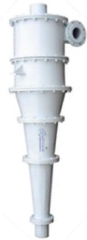
DEFINITION & OVERVIEW
What is a Classifying Cyclone in a Coal Washery?
A classifying cyclone, also called a concentration or classification hydrocyclone separates and classifies fine particles in coal preparation slurry by size and density, using centrifugal force rather than the density-medium separation used in heavy medium cyclones.
Slurry water is pumped from the coal preparation circuit into the cyclone, which completes separation of particles by quality, purifies the water body, improves recovery of fine clean coal, and reduces the solids content carried in circulating water.
John Finlay’s classifying cyclones use 98% alumina ceramic liners, engineered, precision-machined tiles rather than standard cast liners, delivering up to 98% separation efficiency and a 3- to 4-year service life under continuous duty.
How It Works
Slurry enters under pressure; the overflow carries fine, purified product while the underflow discharges concentrated coarser material, with cascade arrangements available for higher capacity.
Wear-Resistant Design
98% alumina ceramic liners at 20mm thickness, precision-engineered for uniform fit, reducing turbulence and localized wear points.
Role in Fines Circuit
Purifies circulating water and improves fine clean coal recovery ahead of or alongside flotation and dewatering stages.
Key Performance Data
Parameter | Value |
|---|---|
Diameter Series | DN300 – DN1250 |
Separation Efficiency | Up to 98% |
Alumina Content | 98% (Mohs hardness ~9) |
Ceramic Tile Thickness | 20mm, engineered/precision-machined |
Service Life | 3–4 years continuous duty |
Working Pressure | 0.08–0.15 MPa |
KEY FEATURES
Key Features & Performance Highlights
John Finlay's Classifying Cyclone is built on the same wear-resistant liner technology used across our cyclone range and engineered specifically for the fine particle sizes and continuous duty of coal preparation slurries.
98% Alumina Ceramic Liners
Compared to the industry-standard 92–95% alumina liners, John Finlay's 98% alumina content delivers a Mohs hardness of approximately 9, second only to diamond on the Mohs scale reducing replacement frequency and downtime by an estimated 30–40% annually versus standard liners.
Engineered, Precision-Machined Tiles
20 mm thick tiles, precision-machined for uniform fit and alignment, minimize wear points and reduce turbulence inside the cyclone, improving slurry flow dynamics and separation efficiency versus normal (non-engineered) tiles.
Full Diameter Series with Cascade Capability
DN300 through DN1250 covers a wide treatment capacity range, and units can be arranged in parallel cascade configurations to reach larger total throughput without a single oversized unit.
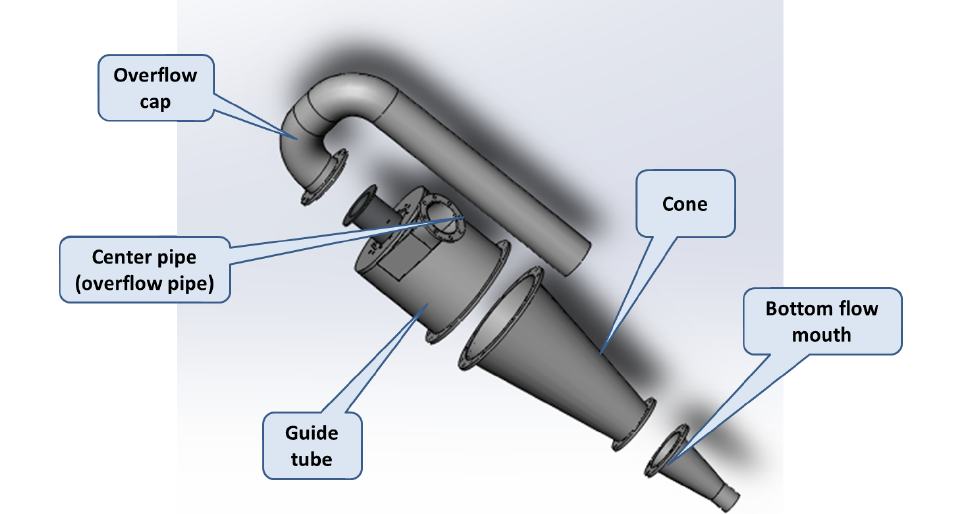
Working Principle
How a Classifying Cyclone Works in Coal Preparation
Understanding the working principle helps process engineers evaluate where a classifying cyclone fits in the fines circuit.
Technical Specifications
Classifying Cyclone | Full Specification Table
John Finlay’s HFC series wet drum magnetic separators are available in two cylinder diameters (914mm and 1219mm), each with five tube length options, covering the full range of magnetite recovery duties in coal preparation plants.
| Model (DN) | Feed Size | Particle Size | Working Pressure | Capacity |
|---|---|---|---|---|
| DN1250 | 0–8mm | 0.075–0.50 mm | 0.10–0.15 MPa | 1160–1260 m³/h |
| DN900 | 0–6mm | 0.075–0.50 mm | 0.10–0.135 MPa | 650–750 m³/h |
| DN500 | 0–5mm | 0.075–0.30 mm | 0.08–0.13 MPa | 160–200 m³/h |
| DN450 | 0–5mm | 0.075–0.30 mm | 0.08–0.13 MPa | 140–180 m³/h |
| DN380 | 0–5mm | 0.075–0.25 mm | 0.08–0.13 MPa | 110–130 m³/h |
| DN350 | 0–5mm | 0.075–0.25 mm | 0.08–0.13 MPa | 70–100 m³/h |
| DN300 | 0–5mm | 0.04–0.15mm | 0.08–0.13 MPa | 50–70 m³/h |
COMPARISON
John Finlay’s Classifying Cyclone vs Standard Market Cyclone
John Finlay (JFE) Classifying Cyclone
Standard Market Cyclone
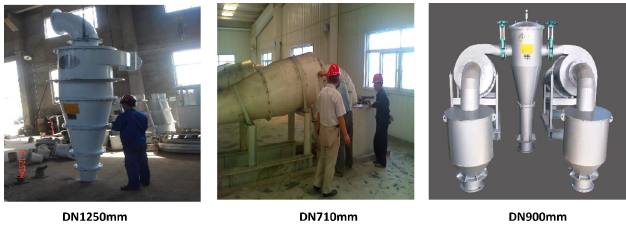
Applications of the Classifying Cyclone in Coal Washing
The Classifying Cyclone is used wherever coal preparation slurry needs particle-size classification, water purification, or fine material concentration.
Fine Coal Slurry Classification
Classifies fine coal particles by size ahead of downstream processing, improving overall circuit efficiency.
Circulating Water Purification
Reduces solids content in circulating water, improving water quality reused elsewhere in the plant.
Clean Coal Recovery Enhancement
Improves recovery of fine, clean coal that would otherwise be lost in the fines circuit.
Ahead of Flotation Circuits
Prepares and classifies feed for froth flotation, improving downstream flotation performance.
Clay Mineral Wet Purification
Also used for wet purification of clay minerals such as bentonite, kaolin, and attapulgite, removing impurities to improve product purity.
High-Capacity Cascade Arrangements
Multiple units run in parallel cascade configurations for treatment capacity beyond a single cyclone's rating.
About John Finlay
Classifying Cyclone Supplier in India
Why John Finlay?
Classifying Cyclone | Frequently Asked Questions
Common questions from coal washery process engineers evaluating classifying cyclone technology.
A classifying cyclone separates fine slurry particles by size and density using centrifugal force alone. A heavy medium cyclone separates coarser coal from reject using a dense medium suspension. Classifying cyclones work on fines and water purification; heavy-medium cyclones work on the main coal versus reject separation.
Selection depends on your slurry flow rate and target particle size cut. John Finlay’s series ranges from DN300 (50–70 m³/h, particle size down to 0.04mm) to DN1250 (1160–1260 m³/h, particle size up to 0.50mm). Contact our engineers with your slurry data for correct sizing, or specify a cascade arrangement for higher capacity.
Higher alumina content increases hardness and wear resistance. Our 98% alumina liners reach a Mohs hardness of approximately 9, second only to diamond on the Mohs scale, versus the 92–95% alumina typical of standard cyclone liners. This reduces replacement frequency and downtime.
Under continuous full-capacity operation, John Finlay’s engineered ceramic liners are designed for 3 to 4 years of service life, compared to a typical 1.5 to 2 years for standard-liner competitor cyclones.
Yes, the same design is also used for wet purification of clay minerals such as bentonite, kaolin and attapulgite, removing impurities to improve product purity.
Need Help Selecting the Right Cyclone for Your Fines Circuit?
Our experts can help you evaluate diameter, staging, and cascade configuration for your slurry classification duty.
Talk to an Expert