
General Instrumentation | Flow Measurement
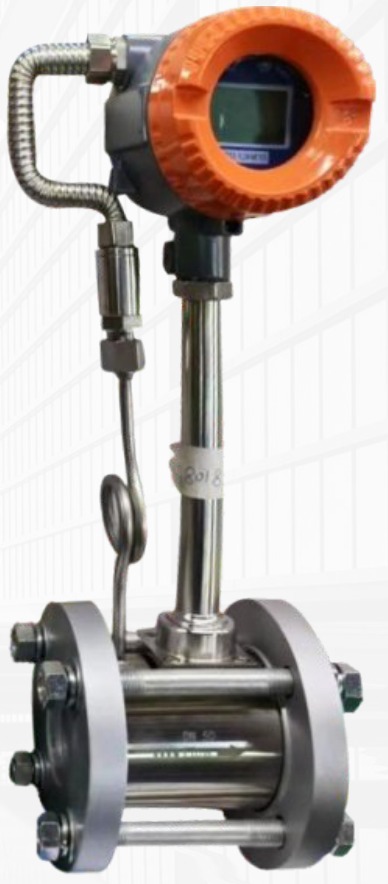
Vortex Flowmeter for Liquids, Gas and Steam
A flowmeter with no moving parts and a working range of -40 to +350 °C. It reads liquids, gases and steam, and its volumetric reading is largely unaffected by density, pressure, temperature and viscosity.
-40 to +350 °C
Working Temperature
Pulse or 4-20 mA
Output
Liquid, gas, steam
Fluids
None
Moving Parts
DEFINITION & OVERVIEW
What is a Vortex Flowmeter?
When a fluid flows past a blunt object, it sheds a steady trail of small whirlpools, called vortices, behind it. The faster the flow, the faster they shed. A vortex flowmeter puts a shaped bar in the pipe, counts the vortices and turns the count into a flow reading.
Because the principle depends on the shape of the flow and not on a spinning part, a vortex meter has no moving parts to wear, jam or need replacing. Its volumetric reading is also largely unaffected by density, pressure, temperature and viscosity, which is why one meter can serve liquids, gases and steam. Volume is not mass, though. For gas and steam, mass flow needs pressure and temperature compensation.
John Finlay's vortex flowmeter works from -40 to +350 °C with low pressure loss, and gives a pulse output or a two-wire 4-20 mA signal. In a coal washery it suits steam, compressed air and gas lines and clean process liquids. For clean single-phase liquids where very high repeatability matters, compare our Turbine Flowmeter. For conductive slurry and water, see our Electromagnetic Flowmeter.
No Moving Parts
The meter counts vortices shed by a bar in the flow, so there is no rotor, bearing or gear to wear out.
One Meter, Three Fluids
Liquids, gases and steam, with volumetric flow largely unaffected by density, pressure, temperature and viscosity.
Hot Lines Included
Working temperature from -40 to +350 °C, so steam and heated lines are inside the range.
Parameter | Value |
|---|---|
Measuring Principle | Vortex shedding |
Fluids | Liquids, gases and steam |
Working Temperature | -40 to +350 °C |
Output | Pulse or two-wire 4-20 mA |
Moving Parts | None |
Pressure Loss | Low |
KEY FEATURES
Key Features & Performance Highlights of Vortex Flowmeter
Low Pressure Loss
The shedder bar creates little restriction, so the meter costs very little pump or compressor energy to run.
Turndown and the Low-Flow Limit
The source describes a wide turndown. Like every vortex meter, it stops reading below a minimum velocity, where the vortices become too weak to count, so it does not read down to zero.
Volumetric Reading Largely Unaffected by Fluid Conditions
The volumetric reading is largely unaffected by density, pressure, temperature and viscosity, so a change in the fluid does not move it the way it would on some other meter types. Mass flow of gas or steam needs pressure and temperature compensation.
Needs Straight Pipe
Vortex meters need a straight pipe upstream and downstream for a steady flow profile and more after a control valve. Under-length pipe is the commonest cause of a poor reading in the field.
Up to +350 °C
A working range from -40 to +350 °C puts steam and hot process lines in reach of a single meter family.
Pulse or 4-20 mA
A pulse output for totalising, or a two-wire 4-20 mA loop for the control system, so it fits an existing PLC without conversion.
WORKING PRINCIPLE
How the Vortex Flowmeter Works
It counts whirlpools. The faster the flow, the faster they form.
Fluid Passes the Bar
Flow in the pipe meets a shaped bar placed across it.
Vortices Are Shed
Behind the bar, the fluid sheds alternating vortices at a rate that rises in step with flow velocity.
The Sensor Counts Them
A sensor picks up the shedding frequency, with no rotating part involved.
Electronics Convert to Flow
The frequency becomes a volumetric flow reading.
Pulse or 4-20 mA Out
The result goes to the control system as a pulse train or a two-wire 4-20 mA signal.
TECHNICAL SPECIFICATIONS
Vortex Flowmeter | Full Specification
Parameter | Specification |
|---|---|
Measuring Principle | Vortex shedding |
Fluids | Liquids, gases and steam |
Working Temperature | -40 to +350 °C |
Output | Pulse or two-wire 4-20 mA |
Moving Parts | None |
Pressure Loss | Low |
COMPARISON
Vortex Flowmeter vs. Turbine Flowmeter
Vortex Flowmeter
Turbine Flowmeter
Applications of the Vortex Flowmeter
For plant lines carrying liquid, gas or steam where a rotating meter is not wanted.
Steam Lines
Reads the volumetric flow of steam within a -40 to +350 °C working range. Steam mass or energy needs pressure and temperature compensation or a flow computer.
Compressed Air and Gas Lines
Volumetric flow of plant air and process gases, with low pressure loss.
Clean Process Liquids
Water and other clean liquid lines where a meter with no moving parts is preferred.
Hot Process Lines
Lines running well above ambient temperature, up to +350 °C.
Plant Line Monitoring
A totalized volumetric pulse output for liquid, air and gas lines across the plant.
Which Flowmeter Do I Need? The Five-Meter Selection Table
Our flow range covers five meters. Start with the fluid, then check the line.
Meter | Best for | Fluid | Moving parts | Output |
|---|---|---|---|---|
Small, repeatable reagent and dosing volumes | Clean liquids | Matched gears | 4-20 mA, pulse, RS485 Modbus-RTU | |
Turbine Flowmeter | Clean liquid lines where repeatability and a simple installation matter | Clean liquids | Rotor | 4-20 mA with pulse, or RS485 |
Vortex Flowmeter | Gas, steam and hot lines, or any line where no moving parts are wanted | Liquids, gases and steam | None | Pulse or 4-20 mA |
Conductive slurry and water in full pipes | Conductive liquids and slurry | none | 4–20 mA and RS485 | |
Partly filled lines | Conductive liquids | None | 4–20 mA (load ≤ 500 Ω) |
About John Finlay
Flow Instrumentation Supplier in India
Why John Finlay?
350 °C
Upper Working Temperature
For steam and hot process lines, with no moving parts to fail in the heat.
130+
Coal Washery Projects
Completed EPC projects worldwide, including Asia’s largest coking coal washery at 30 MTPA.
EPC
Full Circuit Supply
Supplied as part of a complete instrumentation and automation offering across the coal preparation flowsheet.
IN
India-Based Support
Manufactured at Hefei John Finlay Mining Equipment Co., Ltd. and supported locally in India for installation, commissioning, spares and service.
Vortex Flowmeter | Frequently Asked Questions
Common questions from process engineers choosing a flowmeter for liquids, gas or steam.
A shaped bar in the pipe sheds vortices as the fluid passes. The shedding rate rises with flow velocity, so counting the vortices gives the flow, with no moving parts.
Liquids, gases and steam.
The working temperature is -40 to +350 °C.
A pulse output, or a two-wire 4-20 mA signal.
It measures the volumetric flow of steam. Steam is bought and accounted in mass or energy, which needs pressure and temperature compensation or a flow computer.
Use a vortex meter for gas, steam, hot lines or where no moving parts is wanted. Use our Turbine Flowmeter for clean liquid lines where repeatability matters, our Micro Gear Flowmeter for small dosing volumes, and our Electromagnetic Flowmeter for conductive slurry and water.
Need a flowmeter for steam, gas or hot liquid lines?
Our engineers can help you choose the right meter for each line.
Talk to an ExpertRelated Equipment
Turbine Flowmeter
For clean single-phase liquids where repeatability matters.
Electromagnetic Flowmeter
For conductive slurry and water lines.
Non-Full-Pipe Electromagnetic Flowmeter
For partly filled lines.
Instrumentation Overview
All instruments, including the General Instrumentation section.