
Differential Pressure Density Meter
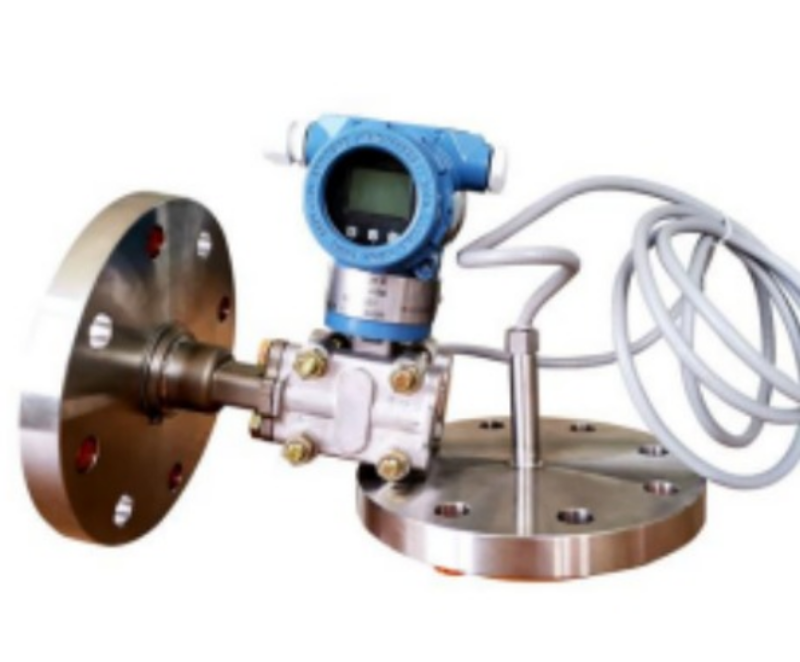
Twin flanged diaphragm seals on a vertical measuring section. The differential pressure between them is a direct function of continuous, accurate suspension density measurement for the correct medium and dilute medium lines.
0 – 4 g/cm³
Density Range
±0.002 g/cm³
Accuracy
0.2 seconds
Response Time
0.1%
Linearity
DEFINITION & OVERVIEW
What is a Differential Pressure Density Meter?
A differential pressure density meter measures suspension density using twin flanged diaphragm seals mounted on a vertical measuring section. The differential pressure between the two seals is a direct function of the fluid column's density, a straightforward, mechanically simple measurement principle with no radioactive source, no AERB licensing, and no moving parts.
John Finlay's unit is an integrated two-wire transmitter, rated across a 0 to 4 g/cm³ density range at ±0.002 g/cm³ accuracy, with a 0.2 second response time fast enough for tight density-loop control on correct medium and dilute medium lines. Temperature compensation is adjustable, and an optional PTFE immersion lining eliminates dead corners and bubble entrapment in the measuring section.
The instrument outputs a standard 4-20 mA two-wire signal with superimposed HART communication, integrating directly into existing dense medium circuit control systems, and displays both density and process temperature locally on a five-digit LCD.
Direct Pressure-to-Density Measurement
Twin flanged diaphragm seals measure differential pressure directly, with no radioactive source, no AERB licensing, and no moving parts.
Fast, Accurate Response
A 0.2-second response time and ±0.002 g/cm³ accuracy support tight density-loop control, not just monitoring.
Simple Two-Wire Integration
4-20 mA output with superimposed HART communication integrates directly into existing control systems via a standard loop-powered connection.
Parameter | Value |
|---|---|
Measuring Principle | Twin flanged diaphragm seals, differential pressure |
Output Signal | 4–20 mA two-wire, superimposed HART |
Power Supply | 12–45 V DC, loop powered |
Density Range | 0 – 4 g/cm³ |
Accuracy | ±0.002 g/cm³ |
Linearity | 0.1% |
Response Time | 0.2 seconds |
Working Velocity | 1.3 – 3 m/s |
Wetted Parts | 316 stainless steel |
Display | Five-digit LCD with temperature value |
KEY FEATURES
Key Features & Performance Highlights
Three features are named directly in John Finlay's own instrumentation documentation.
Integrated Two-Wire Transmitter
No moving parts and simple maintenance, with a five-digit LCD display showing both density and temperature value directly at the instrument.
Adjustable Temperature Compensation
An adjustable compensation range holds measurement accuracy across process temperature variation, rather than a fixed compensation curve.
Optional PTFE Immersion Lining
Eliminates dead corners and bubble entrapment in the measuring section a real contributor to long-term measurement stability on suspension density duty.
WORKING PRINCIPLE
How the Differential Pressure Density Meter Works
Density is calculated directly from a pressure difference between two fixed points on a vertical measuring section.
Vertical Measuring Section
The instrument mounts on a vertical measuring section of the process line, with twin flanged diaphragm seals at two fixed points.
Differential Pressure Sensing
Each diaphragm seal senses the process pressure at its mounting point; the difference between the two readings is measured continuously.
Density Calculation
Because the vertical distance between the seals is fixed and known, the differential pressure is a direct function of the fluid column's density.
Temperature-Compensated Output
Adjustable temperature compensation corrects the reading for process temperature variation before output.
Signal Output
A 4–20 mA two-wire signal with superimposed HART communication feeds the reading to the plant's density control loop.
TECHNICAL SPECIFICATIONS
Differential Pressure Density Meter | Full Specification
Parameter | Specification |
|---|---|
Output Signal | 4–20 mA two-wire, superimposed HART |
Power Supply | 12–45 V DC, loop powered |
Density Range | 0 – 4 g/cm³ |
Accuracy | ±0.002 g/cm³ |
Linearity | 0.1% |
Response Time | 0.2 seconds |
Working Velocity | 1.3 – 3 m/s |
Wetted Parts | 316 stainless steel |
Display | Five-digit LCD with temperature value |
Optional Lining | PTFE immersion lining |
Parameter | Specification |
|---|---|
Output Signal | 4–20 mA two-wire, superimposed HART |
Power Supply | 12–45 V DC, loop powered |
Density Range | 0 – 4 g/cm³ |
Accuracy | ±0.002 g/cm³ |
Linearity | 0.1% |
Response Time | 0.2 seconds |
Working Velocity | 1.3 – 3 m/s |
Wetted Parts | 316 stainless steel |
Display | Five-digit LCD with temperature value |
COMPARISON
Differential Pressure vs. Insertion-Type Density Measurement
Differential Pressure Density Meter
Insertion-Type Density Sensor (Typical)
Applications of the Differential Pressure Density Meter
Named directly in John Finlay's own Dense Medium Control System documentation as the density measurement instrument for correct medium and dilute medium lines.
Correct Medium Density Control
Continuous density measurement on the correct medium line is the primary input to dense medium circuit cut-point control.
Dilute Medium Density Monitoring
Density measurement on the dilute medium line, supporting the medium balance and dilution control loop.
Density-Loop Automation
Fast 0.2 second response and 4–20 mA/HART output support tight, automated density control rather than periodic manual checks.
Dense Medium Control System Integration
Deployed as part of the complete Dense Medium Control System (S1), alongside magnetite concentration, level and pressure instrumentation.
About John Finlay
Density Instrumentation Supplier in India
Why John Finlay?
±0.002
g/cm³ Accuracy
Precise enough for tight density-loop control on correct medium and dilute medium lines.
130+
Coal Washery Projects
Completed EPC projects worldwide, including Asia’s largest coking coal washery at 30 MTPA.
0.2s
Response Time
Fast enough to support automated density-loop control, not just periodic monitoring.
IN
India-Based Support
Manufactured at Hefei John Finlay Mining Equipment Co., Ltd. and supported locally in India for installation, commissioning, spares and service.
Differential Pressure Density Meter | Frequently Asked Questions
Common questions from engineers in coal washery procCommon questions from coal washery process engineers evaluating suspension density measurement.
esses evaluating early-warning blockage detection.
Twin flanged diaphragm seals are mounted on a vertical measuring section. The differential pressure between them is a direct function of the fluid column’s density, no radioactive source, no moving parts.
±0.002 g/cm³ accuracy across a 0 to 4 g/cm³ density range, with 0.1% linearity and a 0.2 second response time.
A 4-20 mA two-wire signal with superimposed HART communication, loop-powered from 12-45 V DC.
As an integrated two-wire transmitter with no moving parts, maintenance is simple. An optional PTFE immersion lining further reduces maintenance by eliminating dead corners and bubble entrapment in the measuring section.
No, because there’s no radioactive source, this instrument doesn’t require AERB licensing, unlike a nucleonic density gauge.
Need continuous, accurate density measurement on your dense medium circuit?
Our engineers can help you specify the right density meter configuration for your correct or dilute medium line.
Talk to an Expert