
GENERAL INSTRUMENTATION | LEVEL & POINT DETECTION
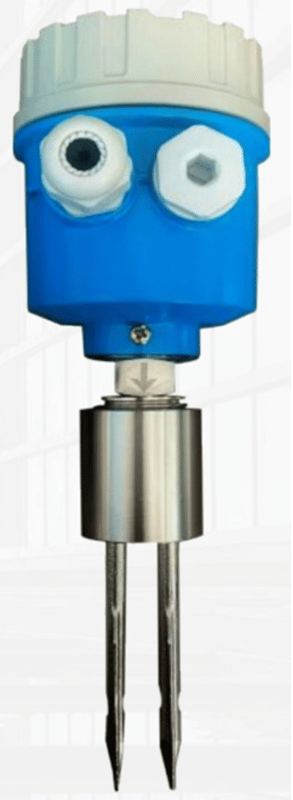
Tuning Fork Level Switch
A piezo-driven fork that detects material contact by frequency shift with no calibration, no moving parts exposed to wear, and a design proven across both liquid and solid point-level detection in demanding plant conditions.
~1 second
Response Time
−30 to +150 °C
Fork Temperature
≤ 2 MPa
Working Pressure
SIL2 / SIL3
Safety Rating
DEFINITION & OVERVIEW
What is a Tuning Fork Level Switch?
A tuning fork level switch detects the presence or absence of material at a fixed point using a piezo-driven fork that vibrates at its natural resonant frequency. When material liquid or solid material contacts the fork, damping shifts that resonant frequency, and the shift switches the output. No calibration is needed, and there are no moving parts exposed to the material stream to wear or foul.
This makes it a standard choice for point-level detection across the process industries generally and specifically useful in coal handling, where a reliable high/low alarm or blockage indicator has to keep working in the presence of dust, moisture, and material carryover that would degrade many other sensing methods.
John Finlay's unit rates for fork temperatures from −30 to +150°C and working pressure up to 2 MPa, with a start-up time of roughly 2 seconds and a response time of about 1 second, is fast enough to catch a developing blockage or level excursion before it becomes a process upset.
No Calibration Required
Frequency-shift detection means the switch is ready to work as installed, with no calibration step and no moving parts exposed to wear.
Liquid and Solid Detection
Rated for media density from 0.7 g/cm³ (liquid) to 0.1 g/cm³ (solid), covering both liquid level and bulk solid point detection.
Functional Safety Rated
Suitable for SIL2/SIL3 functional safety systems, supporting use in safety-instrumented level and blockage detection loops.
Parameter | Value |
|---|---|
Sensing Principle | Piezo-driven tuning fork, resonant frequency shift on contact |
Fork Temperature Range | −30 to +150 °C |
Electronics Temperature Range | −20 to +70 °C |
Working Pressure | ≤ 2 MPa |
Media Density (minimum) | ≥ 0.7 g/cm³ liquid; ≥ 0.1 g/cm³ solid |
Start-Up Time | ~2 seconds |
Response Time | ~1 second |
Power Consumption | 1 W |
Output Options | Relay SPDT/DPDT, PNP/NPN, NAMUR, 8/16 mA |
Safety Rating | Suitable for SIL2/SIL3; IP68 to order |
KEY FEATURES
Key Features & Performance Highlights
Every specification below is drawn directly from John Finlay's own instrumentation documentation.
Fast, Reliable Switching
A start-up time of roughly 2 seconds and a response time of about 1 second mean the switch reacts quickly to a genuine level or blockage event, the difference between an early warning and a process upset already underway.
Wide Media Range
Rated down to 0.7 g/cm³ for liquids and 0.1 g/cm³ for solids, covering a broad range of process media from light powders to dense slurries without needing a different sensor for each.
Flexible Output for Any Control System
Relay SPDT/DPDT, PNP/NPN, NAMUR, and 8/16 mA output versions mean the switch integrates into whatever control architecture is already in place, rather than forcing a specific wiring standard.
WORKING PRINCIPLE
How the Tuning Fork Level Switch Works
Detection depends entirely on a shift in resonant frequency, not a mechanical float or moving part.
Piezo Excitation
A piezoelectric drive oscillates the fork at its natural resonant frequency, continuously, in air.
Material Contact
When a liquid or solid material reaches the fork and contacts the prongs, it damps the vibration.
Frequency Shift Detection
The damping shifts the fork's resonant frequency away from its baseline value in air.
Output Switching
The frequency shift triggers the output switch relay, PNP/NPN, NAMUR, or 4-20 mA, depending on the configuration ordered.
Signal to Control System
The switched output feeds directly into the plant's control system or a safety-instrumented loop, supporting SIL2/SIL3 applications where required.
TECHNICAL SPECIFICATIONS
Tuning Fork Level Switch | Full Specification
Specifications sourced directly from John Finlay’s instrumentation documentation.
Parameter | Specification |
|---|---|
Sensing Principle | Piezo-driven tuning fork |
Fork Temperature Range | −30 to +150 °C |
Electronics Temperature Range | −20 to +70 °C |
Working Pressure | ≤ 2 MPa |
Media Density (minimum) | ≥ 0.7 g/cm³ liquid; ≥ 0.1 g/cm³ solid |
Start-Up Time | ~2 seconds |
Response Time | ~1 second |
Power Consumption | 1 W |
Output Options | Relay SPDT/DPDT, PNP/NPN, NAMUR, 8/16 mA |
Safety Rating | Suitable for SIL2/SIL3; IP68 to order |
COMPARISON
Tuning Fork vs. Float-Type Level Switches
Tuning Fork Level Switch
Float-Type Level Switch (Typical)
Applications of the Tuning Fork Level Switch
Point-level detection is needed throughout a coal washery wherever a specific high, low, or blockage condition needs a fast, reliable switching signal.
High/Low Level Alarming
Standard application alerting operators or triggering an interlock when material reaches a defined high or low point in a tank, bin, or hopper.
Overflow Prevention
Detects an approaching overflow condition in time to trigger a pump stop or diversion before material actually overflows.
Pump Protection
Prevents a pump from running dry by detecting low-level conditions in the feed vessel.
Blockage and Carry-Over Detection
The same frequency-shift principle is used in JFI's own Screen Underflow Anti-Blockage Detection System (S4); see that page for the full packaged application.
Safety-Instrumented Level Loops
SIL2/SIL3 suitability supports use in safety-critical level detection applications, not just general process alarming.
Bin and Silo Level Detection
Detects material presence in bulk solids storage, suited to the 0.1 g/cm³ minimum solid density rating.
About John Finlay
Level Instrumentation Supplier in India
Why John Finlay?
SIL2/3
Functional Safety Rating
Suitable for safety-instrumented level detection loops, not just general process alarming.
130+
Coal Washery Projects
Completed EPC projects worldwide, including Asia’s largest coking coal washery at 30 MTPA.
EPC
Full Circuit Supply
Supplied as part of complete process equipment packages for both coal and non-coal mineral processing circuits.
IN
India-Based Support
Manufactured at Hefei John Finlay Mining Equipment Co., Ltd. and supported locally in India for installation, commissioning, spares and service.
Tuning Fork Level Switch | Frequently Asked Questions
Common questions from coal washery process engineers evaluating point-level detection.
A piezoelectric drive vibrates the fork at its natural resonant frequency. When material contacts the fork, damping shifts that frequency, and the shift switches the output to no moving parts, with no calibration required.
Yes, it is rated for media density down to 0.7 g/cm³ for liquids and 0.1 g/cm³ for solids, covering a wide range of process media.
Yes, vibrating/tuning fork detection for coal screen blockage and level applications is an established technique in coal-fired power and coal handling generally, independently of any single manufacturer.
Approximately 1 second, with a start-up time of around 2 seconds, is fast enough to catch a developing level or blockage condition early.
Yes, the switch is suitable for SIL2/SIL3 functional safety systems, supporting use in safety-instrumented loops as well as general process alarming.
Need reliable point-level detection that won't foul or need recalibration?
Our engineers can help you specify the right tuning fork configuration for your application.
Talk to an ExpertRelated Equipment
Screen Underflow Anti-Blockage Detection (S4)
The packaged system built around this exact sensing technology.
Instrumentation Hub
All packaged instrumentation systems, grouped by process area.
Radar Level Transmitter
Continuous level measurement for when a single switch point isn't enough.