
General Instrumentation | Flow Measurement
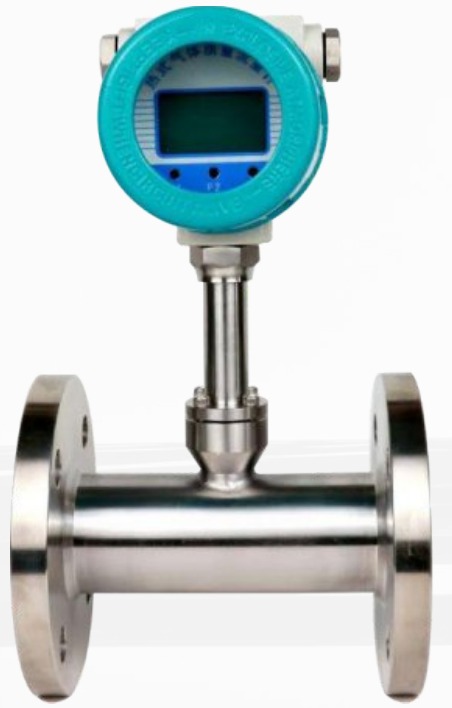
Thermal Mass Air Flowmeter
True mass flow of air and gas, with no temperature or pressure compensation needed. A 100:1 turndown, velocity from 0.1 to 120 Nm/s, and no moving or pressure-sensing parts.
0.1-120 Nm/s
Velocity Range
100:1
Turndown
±1.0% / ±1.5%
Accuracy
IP65, Exd IIC T4
Protection
DEFINITION & OVERVIEW
What is a Thermal Mass Air Flowmeter?
A thermal mass flowmeter heats a small sensing element and measures how much heat the passing gas carries away. The more gas that flows, the more heat it removes. Because that cooling depends on how many gas molecules pass the sensor, not on how much space they take up, the reading is a true mass flow.
That is the main reason to choose one. A volumetric meter reads the volume of gas going by, and to turn that into mass, it needs a separate pressure and temperature measurement and a calculation. A thermal mass meter reads mass directly, so no temperature or pressure compensation is required, and the instrument is simpler to fit and to trust.
John Finlay's thermal mass air flowmeter measures velocity from 0.1 to 120 Nm/s with a 100:1 turndown, so it reads very low flows as well as high ones. It comes in an inline version from DN10 to DN300 and an insertion version for DN40 and above, works to 4.0 MPa, and has no moving or pressure-sensing parts, so vibration does not affect its accuracy. For liquids, gas and steam by volume, compare our Vortex Flowmeter.
Reads Mass Directly
True mass flow, with no temperature or pressure compensation required.
100:1 Turndown
Reads from 0.1 to 120 Nm/s, so a line that runs light for part of the day is still measured.
No Moving Parts
No moving or pressure-sensing parts, so vibration does not affect accuracy.
Parameter | Value |
|---|---|
Measuring Principle | Thermal mass flow |
Velocity Range | 0.1 to 120 Nm/s |
Turndown | 100:1 |
Accuracy | ±1.0% / ±1.5% |
Line Size | Inline DN10 to DN300; insertion DN40 and above |
Working Pressure | Up to 4.0 MPa |
Output | RS-485 or HART, with 4-20 mA |
Protection | IP65, Exd IIC T4 |
Response | 1 s or less |
KEY FEATURES
Key Features & Performance Highlights of Thermal Mass Air Flowmeter
True Mass Flow, Straight from the Sensor
No temperature or pressure compensation is required, so there is no second and third instrument to buy, wire and keep calibrated. The reading is mass flow from the start.
A 100:1 Turndown
With a velocity range of 0.1 to 120 Nm/s, one meter covers a line that runs near idle and at full load, which is where many volumetric meters give up at the low end.
Inline or Insertion
The inline version covers DN10 to DN300. The insertion version suits DN40 and above, so a large duct or pipe can be measured without cutting a full spool piece.
Unaffected by Vibration
There are no moving or pressure-sensing parts, so plant vibration does not affect the accuracy. That matters near compressors, fans and crushers.
Fast Response and Standard Signals
A response of 1 s or less, with RS-485 or HART alongside 4-20 mA, so it fits an existing control system.
WORKING PRINCIPLE
How the Thermal Mass Air Flowmeter Works
It measures how much heat the gas carries away.
A Sensing Element Is Heated
A small heated element sits in the gas stream.
The Gas Cools It
Moving gas carries heat away from the element. The more gas mass passes, the more heat is removed.
The Electronics Measure the Heat Loss
The electronics measure the energy needed to hold the element at its working condition and convert it to a mass flow.
Mass Flow Is Calculated
The result is mass flow directly, with no separate temperature or pressure compensation.
Signal to the Control System
Output goes to the plant over RS-485 or HART, with 4-20 mA, with a response of 1 s or less.
TECHNICAL SPECIFICATIONS
Thermal Mass Air Flowmeter | Full Specification
Parameter | Specification |
|---|---|
Measuring Principle | Thermal mass flow, true mass flow |
Compensation | No temperature or pressure compensation required |
Velocity Range | 0.1 to 120 Nm/s |
Turndown | 100:1 |
Accuracy | ±1.0% / ±1.5% |
Line Size | Inline DN10 to DN300; insertion DN40 and above |
Working Pressure | Up to 4.0 MPa |
Output | RS-485 or HART, with 4-20 mA |
Protection | IP65, Exd IIC T4 |
Response | 1 s or less |
Moving and Pressure-Sensing Parts | None; vibration does not affect accuracy. |
COMPARISON
Thermal Mass Air Flowmeter
Vortex Flowmeter
Applications of the Thermal Mass Air Flowmeter
Wherever air or gas has to be measured as mass.
Compressed Air Lines
Measures plant compressed air consumption, a common first step in finding leaks and managing energy costs.
Process Air Supply
Measures air delivered to process equipment such as our Flotation Machine.
Combustion and Process Air
Mass flow of air to burners and dryers, where the oxygen delivered matters, not the volume.
Ducts and Large Lines
The insertion version measures large pipes and ducts from DN40 upward without a full inline section.
Low-Flow Lines
A 100:1 turndown and a 0.1 Nm/s lower limit keep reading when the line runs near idle.
Which Flowmeter Do I Need? The Six-Meter Selection Table
Our flow range covers five meters. Start with the fluid, then check the line.
Meter | Best for | Fluid | Moving parts | Output |
|---|---|---|---|---|
Thermal Mass Air Flowmeter | True mass flow of air and gas | Air and gas | None | 4-20 mA with RS-485 or HART |
Vortex Flowmeter | Gas, steam, and hot lines, or any line where no moving parts is wanted | Liquids, gases and steam | None | Pulse or 4-20 mA |
Turbine Flowmeter | Clean liquid lines where repeatability and a simple installation matter | Clean liquids | Rotor | 4-20 mA with pulse, or RS485 |
Vortex Flowmeter | Gas, steam and hot lines, or any line where no moving parts are wanted | Liquids, gases and steam | None | Pulse or 4-20 mA |
Conductive slurry and water in full pipes | Conductive liquids and slurry | none | 4–20 mA and RS485 | |
Partly filled lines | Conductive liquids | None | 4–20 mA (load ≤ 500 Ω) |
About John Finlay
Flow Instrumentation Supplier in India
Why John Finlay?
100:1
Turndown
From 0.1 to 120 Nm/s, in a true mass flow meter with no compensation.
130+
Coal Washery Projects
Completed EPC projects worldwide, including Asia’s largest coking coal washery at 30 MTPA.
EPC
Full Circuit Supply
Supplied as part of a complete instrumentation and automation offering across the coal preparation flowsheet.
IN
India-Based Support
Manufactured at Hefei John Finlay Mining Equipment Co., Ltd. and supported locally in India for installation, commissioning, spares and service.
Thermal Mass Air Flowmeter | Frequently Asked Questions
Common questions from plant engineers measuring air and gas flow.
Volumetric flow is the space the gas takes up as it passes. Mass flow is the amount of gas that passes. Gas volume changes with pressure and temperature, so a volumetric meter needs compensation to give mass, while a thermal mass meter reads mass directly.
No. A thermal mass flowmeter reads true mass flow, so no temperature or pressure compensation is required.
Velocity from 0.1 to 120 Nm/s with a 100:1 turndown.
Inline meters from DN10 to DN300, and insertion meters for DN40 and above.
±1.0% or ±1.5%, depending on the version.
It is rated IP65 and Exd IIC T4.
It is supplied as an air flowmeter. A thermal meter is calibrated for the gas it measures, so ask our engineers about other gases.
Need to measure air or gas as true mass flow?
Our engineers can help you choose the right meter for each line.
Talk to an ExpertRelated Equipment
Vortex Flowmeter
No moving parts for liquids, gases and steam.
Turbine Flowmeter
For clean single-phase liquids where repeatability matters.
Electromagnetic Flowmeter
For conductive slurry and water lines.
Micro Gear Flowmeter
For small, repeatable dosing volumes.
Instrumentation Overview
All instruments, including the General Instrumentation section.