
General Instrumentation | Level Measurement
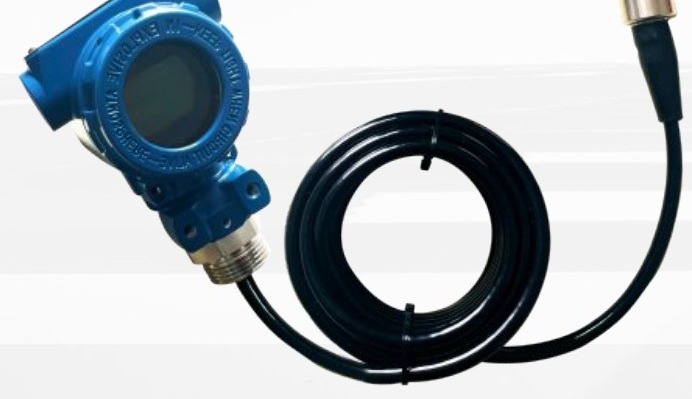
Submersible Level Transmitter for Sumps and Tanks
Lower it into the liquid and read the level from the pressure above it. Protected against reverse polarity, lightning and RF interference, with ±0.2% FS typical accuracy and a two-wire 4-20 mA signal.
±0.2% FS
Typical Accuracy
4-20 mA, 2-wire
Output
12-36 V DC
Supply
Lightning and RF
Protection
DEFINITION & OVERVIEW
What is a Submersible Level Transmitter?
A submersible level transmitter sits in the liquid itself. A pressure sensor at the bottom of the unit reads the weight of the liquid above it, and because that weight rises and falls in direct proportion to depth, the pressure reading becomes a level reading. A cable carries the signal up to the control system and also supplies a reference to the atmosphere.
That makes it one of the simplest ways to measure the level in a sump, pit, well or tank. There is no gauge board to read, no float to jam, and no need for a clear view of the surface, so foam or a covered tank does not get in the way.
John Finlay's submersible level transmitter has a typical accuracy of ±0.2% FS, runs on 12 to 36 V DC and sends a two-wire 4-20 mA signal. It has reverse polarity and current limiting protection and lightning and RF protection built in. Unlike our Differential Pressure Level Transmitter, which reads differential pressure on a sump line or vessel, this unit hangs in the liquid itself on a cable. For plain pressure points, see our Pressure Transmitter. For non-contact options, see our Radar Level Transmitter and Ultrasonic Level Transmitter.
Reads Level from Pressure
The pressure of the liquid above the sensor gives level directly, so foam or a covered tank does not disturb it.
Built-In Electrical Protection
Reverse polarity, current limiting, lightning and RF protection are built in to ride out wiring errors, faults and electrical interference.
Plain Two-Wire 4-20 mA
A 12 to 36 V DC supply and one two-wire loop keep wiring and replacement simple.
Parameter | Value |
|---|---|
Measuring Principle | Hydrostatic pressure of the liquid above the sensor |
Typical Accuracy | ±0.2% FS |
Supply | 12-36 V DC |
Output | 4-20 mA, two-wire |
Protection | Reverse polarity, current limiting, lightning and RF |
KEY FEATURES
Key Features & Performance Highlights for Submersible Level Transmitter
Accuracy Stated as a Percentage of Full Scale
±0.2% FS typical is a plain statement of the error band across the whole range, so a specifying engineer knows what to expect without guessing the basis.
Intrinsically Safe
Built for areas where energy has to be limited, so it can go where a standard transmitter cannot.
Protected Against the Plant Environment
Reverse polarity and current limiting protection guard against wiring errors and faults, and lightning and RF protection help the signal ride out electrical interference and storms.
Simple Two-Wire Installation
One cable, a 12 to 36 V DC supply and a 4-20 mA loop. Lower it in, connect it and read it.
No Moving Parts to Stick
Pressure sensing leaves no float or mechanism to jam, which keeps maintenance low.
WORKING PRINCIPLE
How the Submersible Level Transmitter Works
Depth of liquid creates pressure. The transmitter reads it.
Lower into the Liquid
The transmitter is lowered into the sump or tank on its cable to a fixed position near the bottom.
Pressure Rises with Depth
The deeper the liquid above the sensor, the greater the pressure on it, in direct proportion.
The Sensor Reads the Pressure
The sensing element converts the pressure to an electrical signal, with ±0.2% FS typical accuracy.
Signal on a Two-Wire Loop
The result travels as a 4-20 mA signal on a 12 to 36 V DC supply, with protection against reverse polarity, overcurrent, lightning and RF.
Level in the Control System
The control system scales 4-20 mA to level, and the operator sees depth on the plant screen.
TECHNICAL SPECIFICATIONS
Submersible Level Transmitter | Full Specification
Parameter | Value |
|---|---|
Measuring Principle | Hydrostatic pressure of the liquid above the sensor |
Typical Accuracy | ±0.2% FS |
Supply Voltage | 12-36 V DC |
Output | 4-20 mA, two-wire |
Electrical Protection | Reverse polarity, current limiting, lightning and RF |
Hazardous Area | Intrinsically safe |
COMPARISON
Submersible vs. Non-Contact Level Transmitters
Submersible Level Transmitter
Radar and Ultrasonic (Non-Contact)
Applications of the Submersible Level Transmitter
Wherever a sump, pit or tank needs a steady level signal.
Sump and Pit Level
Tracks level in plant sumps and pits to start and stop pumps.
Water Tanks and Reservoirs
Measures process water and clarified water tank level.
Pump Protection
A continuous level signal supports low-level pump trip and high-level alarm.
Hazardous Areas
Intrinsic safety allows installation where energy must be limited.
Wells and Boreholes
Hangs on a cable to measure water level in a well.
About John Finlay
Level Instrumentation Supplier in India
Why John Finlay?
±0.2%
Typical Accuracy (FS)Error
A plain percentage of full scale, stated explicitly.
130+
Coal Washery Projects
Completed EPC projects worldwide, including Asia’s largest coking coal washery at 30 MTPA.
EPC
Full Circuit Supply
Supplied as part of a complete instrumentation and automation offering across the coal preparation flowsheet.
IN
India-Based Support
Manufactured at Hefei John Finlay Mining Equipment Co., Ltd. and supported locally in India for installation, commissioning, spares and service.
Submersible Level Transmitter | Frequently Asked Questions
Common questions from process engineers choosing sump and tank level measurement.
It sits in the liquid and measures the pressure of the liquid above it. That pressure rises in direct proportion to depth, so it converts directly to level.
A two-wire 4-20 mA signal on a 12 to 36 V DC supply.
The unit has reverse polarity, current limiting, lightning and RF protection.
Yes. Pressure depends on the density of the liquid as well as its depth, so the reading suits liquids of steady density, such as water. Where density varies, ask our engineers about compensation.
When you want nothing in the liquid, or when a tall vessel or silo is involved. See our Radar Level Transmitter and Ultrasonic Level Transmitter pages.
Need a dependable level signal for a sump or tank?
Our engineers can help you choose the right level measurement for each point.
Talk to an ExpertRelated Equipment
Radar Level Transmitter
Non-contact radar level for tall vessels.
Ultrasonic Level Transmitter
Non-contact level to 15 m.
Pressure Transmitter
For pressure points rather than level.
Differential Pressure Level Transmitter
Hydrostatic level for dense medium sumps.