
CYCLONES | WEAR-RESISTANT LINER TECHNOLOGY
Hydro Cyclone
Built around a 98%-pure silicon carbide liner that outlasts standard hydrocyclone liners 3 to 1—with real field ROI data behind that number, not a marketing claim. The same platform serves six industries beyond coal: clay minerals, non-metallic minerals, metal ores, bauxite, power plant desulfurization, and sand making.
3x Longer (est. 3 yrs vs. 1 yr)
Liner Life
Mohs 9.5
Liner Hardness
66%
Downtime Reduction
₹1.2 Cr per plant
3-Year Savings
DEFINITION & OVERVIEW
What is a hydro cyclone?
A hydrocyclone separates two phases of a mineral slurry, typically by particle size or density, using centrifugal force generated by tangential feed entry and has no moving parts. It's one of the most widely used classification devices across mining, coal, power, oil and other basic energy industries, precisely because the same underlying principle scales from a few liters an hour up to hundreds of cubic meters an hour depending on diameter.
What actually determines a hydrocyclone's working life is the liner, not the shell. The liner is what's in continuous contact with abrasive slurry, and John Finlay's Hydro Cyclone range is built around a high-purity α-SiC (silicon carbide, ≥98% purity) liner rather than the silicon nitride-bonded SiC blends (typically SiC 75% + Si₃N₄/Si₂ON₂ 25%) common on competitor units.
That liner difference is why John Finlay's Hydro Cyclone range serves six real industries beyond coal washing specifically: clay mineral wet purification, non-metallic mineral classification, metal ore desliming and tailings treatment, bauxite processing for alumina plants, limestone/gypsum classification in coal-fired power plant desulfurization, and sand making, each running the same liner technology against a different abrasive duty.
98% Pure Silicon Carbide Liner
α-SiC ≥98% purity, Mohs hardness 9.5, nearly as hard as diamond versus the silicon nitride-bonded blends common on competitor liners.
Real Field ROI, Not a Claim
3x liner life, 66% less downtime, ₹1.2 Cr in savings over 3 years per plant figure from an actual technical and commercial comparison, not a brochure estimate.
One Liner, Six Industries
The same wear-resistant liner technology runs across clay minerals, non-metallic minerals, metal ores, bauxite, power plant FGD, and sand making.
Parameter | Value |
|---|---|
Liner Material | α-SiC ≥98% purity (vs. SiC 75% + Si₃N₄/Si₂ON₂ 25% typical) |
Hardness | Mohs 9.5 (vs. lower hardness on nitride-bonded blends) |
Apparent Porosity | ≤1% (vs. ~8% typical, GPa, 80% lower) |
Modulus of Elasticity | ~450 GPa (vs. ~200 GPa typical 2.25x stiffer) |
Modulus of Rupture | ~400–500 MPa (vs. the typical ~65 MPa) (vs. the typical ~7x stronger) |
Estimated Liner Lifespan | 3 years (vs. 1 year, 3x longer) |
Diameter Range (multi-industry) | DNDN10–DN900 crosses six application series |
KEY FEATURES
Key Features & Performance Highlights
The liner is the differentiator. Every figure below is drawn from a real technical and commercial comparison, not a general marketing claim.
3x Longer Liner Life, 80% Lower Porosity
The α-SiC liner, with ≥98% purity, has an estimated lifespan of 3 years, compared to roughly 1 year for a typical SiC 75%/nitride-bonded blend liner. Apparent porosity of ≤1%, against ~8% typical, is a large part of why lower porosity means less erosion and material loss over time.
Higher Stiffness and Fracture Resistance
A modulus of elasticity around 450 GPa (versus ~200 GPa typical) means the liner holds its structural integrity under load rather than deforming, while a modulus of rupture of 400–500 MPa (versus ~65 MPa typical) roughly 7x higher means it resists cracking under mechanical stress that would damage a standard liner.
Real Downtime and Cost Impact
On a 2 MTPA washery running 12 hydrocyclones, John Finlay's liner is estimated to save ₹40 lakhs/year on liner replacements, ₹30 lakhs/year from a 66% reduction in downtime, and ₹10 lakhs/year in maintenance labor and logistics, for a total of roughly ₹1.2 crore over three years per plant.
WORKING PRINCIPLE
How a Hydro Cyclone Works
Separation happens through centrifugal force generated entirely by the geometry of the cyclone and the pressure of the feed.
Tangential Feed Entry (Inlet Head)
Slurry enters the cyclone under pressure through the inlet head, tangentially, immediately setting up a spiral flow pattern.
Centrifugal Separation (Barrel and Cone)
The spiral motion through the barrel and cone generates centrifugal force, driving coarser or denser particles toward the wall and finer or lighter particles toward the center.
Underflow Discharge (Spigot)
Coarser or denser material reports to the underflow through the spigot, where it is concentrated for further processing or as the coarse product.
Overflow Discharge (Vortex Finder)
Finer or lighter material, along with clarified water, reports to the overflow through the vortex finder for recycling or as the fine product.
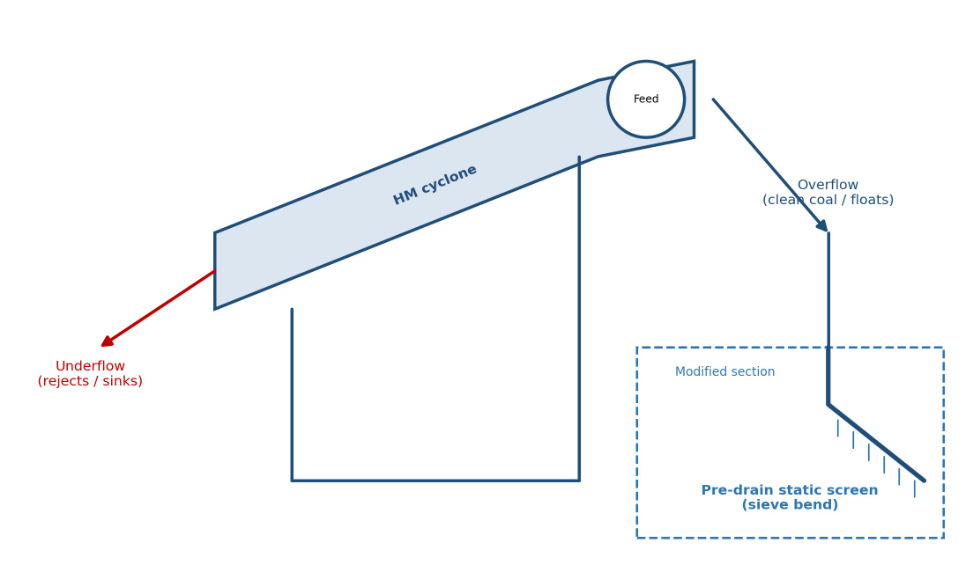
Optional Pre-Drain Sieve Bend
Where the overflow needs partial dewatering before its next process stage, a static sieve bend screen can be fitted on the overflow line ahead of the drain, a modification, not a standard fitting, specified where the downstream circuit benefits from it.
Cascade for Higher Capacity
Where a single unit's capacity isn't sufficient, cyclones are arranged in parallel cascade clusters, the same approach used across all six application series in this range.
TECHNICAL SPECIFICATIONS
Hydro Cyclone | Liner Comparison and Application Specification
Two real data sets: the liner material comparison behind the ROI claims above and the diameter/capacity range across six application industries.
Application | Diameter Range | Feed / Particle Size | Capacity |
|---|---|---|---|
Clay Minerals (bentonite, kaolin, attapulgite) | DN10 – DN100 | 0–0.25 mm feed; 0.0013–0.075mm particle | 0.06 – 12 m³/h |
Non-Metallic Minerals (fluorite, barite, feldspar, phosphate) | DN100 – DN500 | 0–3 mm feed; 0.02–0.15mm particle | 9 – 220 m³/h |
Metal Ores (ferrous & non-ferrous desliming, tailings) | DN300 – DN900 | 0–8 mm feed; 0.075–0.50mm particle | 50–780 m³/h |
Bauxite Processing (alumina plants) | DN150 – DN500 | 0–3 mm feed; 0.02–0.15mm particle | 15–220 m³/h |
Coal-Fired Power Plant FGD (limestone, gypsum) | DN300 – DN500 | above and0–5 mm feed; 0.075–0.30mm particle | 50–220 m³/h |
Sand Making (building materials) | DN100 – DN500 | 0–3 mm feed; 0.02–0.15mm particle | 9 – 220 m³/h |
COMPARISON
John Finlay α-SiC Liner vs. Standard Liner
John Finlay Liner—α-SiC ≥98%
Standard Liner SiC 75% + Si₃N₄/Si₂ON₂ 25%
Applications of the Hydro Cyclone
Six real, distinct industries use this cyclone and liner platform, each with its own diameter series matched to the material being processed.
Clay Mineral Wet Purification
Removes impurities from bentonite, kaolin and attapulgite by wet process, improving the purity of valuable clay minerals.
Non-Metallic Mineral Classification
Classification, separation and desliming of fluorite, barite, feldspar, spodumene, potassium salt ore, phosphate ore and graphite.
Metal Ore Desliming and Tailings Treatment
Classification, desliming, pulp concentration and tailings treatment for ferrous and non-ferrous ores.
Bauxite Processing for Alumina Plants
Separates high-alumina minerals from low-alumina minerals and gangue, improving bauxite concentrate quality and yield.
Coal-Fired Power Plant Wet FGD
Limestone grinding classification, gypsum concentration and recovery, and wastewater purification in the desulfurization process.
Sand Making for Building Materials
Used in river and mountain sand production, recovering fine sand and recycling water, typically paired with a vibrating screen.
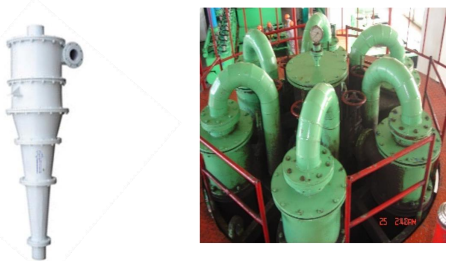
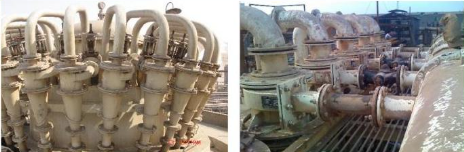
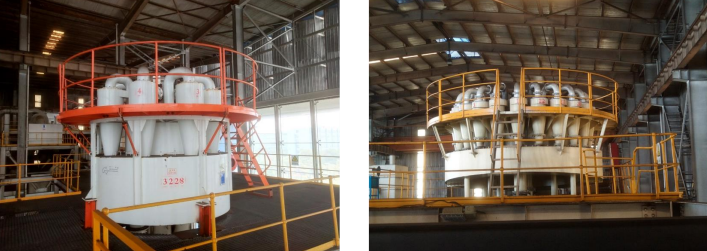
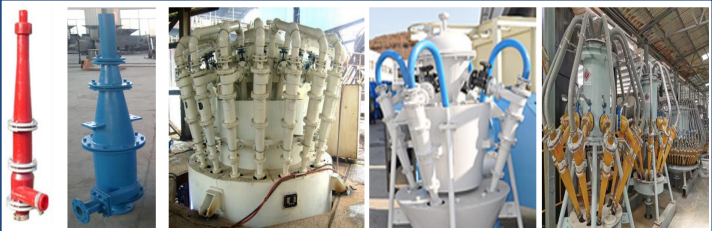
Real Field Installations Across Our Six Industries
About John Finlay
Hydrocyclone Manufacturer and Supplier in India
Why John Finlay?
3x
Liner Lifespan
α-SiC ≥98% purity liner, estimated 3 years versus 1 year for a typical nitride-bonded blend liner.
130+
Coal Washery Projects
Completed EPC projects worldwide, including Asia’s largest coking coal washery at 30 MTPA.
EPC
Full Circuit Supply
Supplied as part of complete process equipment packages for both coal and non-coal mineral processing circuits.
IN
India-Based Support
Manufactured at Hefei John Finlay Mining Equipment Co., Ltd. and supported locally in India for installation, commissioning, spares and service.
Hydro Cyclone | Frequently Asked Questions
Common questions from process engineers evaluating hydrocyclones and liner technology for mineral processing applications.
It’s a high-purity α-SiC (silicon carbide, ≥98% purity) liner, against the SiC 75% + silicon nitride-bonded blends common on competitor units. The higher purity gives a Mohs hardness of 9.5, an apparent porosity of ≤1% (versus ~8% typical), and an estimated 3-year lifespan versus roughly 1 year for a standard liner.
On a 2 MTPA washery running 12 hydrocyclones, John Finlay’s liner is estimated to save around ₹1.2 crore over three years per plant from longer liner life, a 66% reduction in downtime, and lower maintenance labor and logistics costs.
Classifying Cyclone and HM Cyclone are purpose-built for coal preparation, fine coal slurry classification, and dense medium separation, respectively. Hydro Cyclone is the general-purpose platform serving six other industries: clay minerals, non-metallic minerals, metal ores, bauxite, power plant FGD, and sand making.
Our engineers can run the same cost comparison against your current liner and duty cycle.
1 mm across the full 0 to 15m range.
Not sure if ultrasonic or radar is the right fit for your level point?
Our engineers can help you match the instrument to your actual environment and range requirement.
Talk to an Expert