
Signal Isolators and Transmitters for Plant Control Loops
Signal Isolators and Transmitters
Fully three-port isolated modules that pass, convert and power plant signals. 1-in-1-out, 1-in-2-out or 2-in-2-out, 0.1% total accuracy, a universal input version, and plug-in construction on 35 mm DIN rail.
0.1%
Total Accuracy
3-port
Isolation
1-in-1 to 2-in-2
Channels
35 mm DIN rail
Mounting
DEFINITION & OVERVIEW
What is a Signal Isolator?
A signal isolator sits between a field instrument and a control system and passes the signal across an electrical barrier. The signal goes through. Stray voltage, noise and ground currents do not.
In a large plant that matters. Instruments are far from the control room, earthed at different points, and share cable routes with motors and drives. The result is ground loops, drifting readings and signals that interfere with each other. An isolator breaks the electrical path while keeping the information, and a good one can also power the field transmitter and split one signal to two destinations.
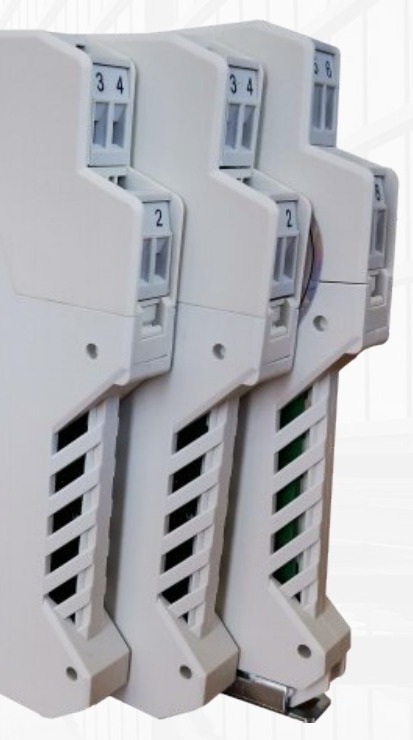
John Finlay's signal isolators and transmitters are fully isolated across three ports, input, output and supply. They come as 1-in-1-out, 1-in-2-out and 2-in-2-out modules, supply loop power to two- and three-wire field transmitters, and accept 4-20 mA or 0-20 mA input. They output 4-20 mA, 0/1-5 V or 0/2-10 V, with 0.1% total accuracy, and plug in on a 35 mm DIN rail. A universal input version accepts temperature, current, voltage and resistance. They work with instruments such as our Pressure Transmitter and Differential Pressure Level Transmitter and with the signals from our Belt Weigher and Weigh Feeder.
Isolated on Every Port
Input, output and supply are all electrically isolated from each other, so a fault or noise on one side does not cross to the other.
Powers the Field Instrument
The input side supplies loop power to two- and three-wire field transmitters, so a separate supply is not needed.
Set by Software
Input type and range are software-configurable, and plug-in construction makes a module quick to swap.
Parameter | Value |
|---|---|
Channel Formats | 1-in-1-out, 1-in-2-out, 2-in-2-out |
Isolation | Full three-port: input, output and supply |
Input | 4-20 mA, 0-20 mA |
Output | 4-20 mA, 0/1-5 V, 0/2-10 V |
Universal Input Version | Temperature, current, voltage and resistance |
Total Accuracy | 0.1% |
Configuration | Software-configurable input type and range |
Construction | Plug-in, on 35 mm DIN rail |
KEY FEATURES
Key Features & Performance Highlights of Signal Isolators and Transmitters
Full Three-Port Isolation
Input, output and supply are isolated from one another. That stops ground loops and protects the control system's input cards from a fault on the field side.
Powers Two- and Three-Wire Transmitters
The input side supplies loop power, so the module can feed a field transmitter directly and pass its 4-20 mA signal on.
One Signal, Two Destinations
1-in-2-out modules split a single input to two outputs, for example, one to the PLC and one to a local indicator or recorder, while keeping the two isolated.
Universal Input Version
One module accepts temperature, current, voltage and resistance, so fewer spares cover many signal types.
Software-Configurable, Plug-In
The input type and range are set in software to 0.1% total accuracy, and the module plugs in on a 35 mm DIN rail for quick replacement.
WORKING PRINCIPLE
How a Signal Isolator Works
It carries the information across and leaves the electrical noise behind.
Signal Arrives
The module takes in a field signal, such as 4-20 mA from a transmitter, or a temperature, voltage or resistance signal on the universal version.
Loop Power Is Supplied If Needed
For a two- or three-wire field transmitter, the input side supplies loop power.
The Signal Crosses the Barrier
The signal is conditioned and passed across a full isolation barrier, with input, output and supply isolated from each other.
Conversion
The output is produced as 4-20 mA, 0/1-5 V or 0/2-10 V, to 0.1% total accuracy.
Into the Control System
The clean, isolated signal reaches the PLC or indicator.
TECHNICAL SPECIFICATIONS
Signal Isolators and Transmitters | Full Specification
Parameter | Value |
|---|---|
Channel Formats | 1-in-1-out, 1-in-2-out, 2-in-2-out |
Isolation | Full three-port: input, output and supply |
Input | 4-20 mA, 0-20 mA |
Output | 4-20 mA, 0/1-5 V, 0/2-10 V |
Universal Input Version | Temperature, current, voltage and resistance |
Loop Power | Supplied on the input side to two- and three-wire transmitters |
Total Accuracy | 0.1% |
Configuration | Software-configurable input type and range |
Construction | Plug-in, on 35 mm DIN rail |
COMPARISON
With a Signal Isolator
Direct-Wired
Applications of Signal Isolators and Transmitters
Wherever field signals meet a control system.
Breaking Ground Loops
Cures drifting readings caused by different earth potentials between the field and the control room.
Powering Field Transmitters
Feeds loop power to two- and three-wire instruments directly from the module.
Splitting Signals
Sends one reading to the PLC and a local display or recorder, each isolated.
Converting Signals
Turns 4-20 mA into 0/1-5 V or 0/2-10 V for equipment that needs voltage inputs.
Temperature and Mixed Signals
The universal input version handles temperature, current, voltage and resistance with one module type.
About John Finlay
Signal Conditioning Supplier in India
Why John Finlay?
0.1%
Total Accuracy
With software-configurable input type and range.
130+
Coal Washery Projects
Completed EPC projects worldwide, including Asia’s largest coking coal washery at 30 MTPA.
EPC
Full Circuit Supply
Supplied as part of a complete instrumentation and automation offering across the coal preparation flowsheet.
IN
India-Based Support
Manufactured at Hefei John Finlay Mining Equipment Co., Ltd. and supported locally in India for installation, commissioning, spares and service.
Signal Isolators and Transmitters | Frequently Asked Questions
Common questions from control engineers choosing signal conditioning.
It passes a signal across an electrical barrier. The information goes through, while noise, stray voltage and ground currents do not.
Input, output and supply are all electrically isolated from each other, so a problem on one cannot cross to another.
Yes. The input side supplies loop power to two- and three-wire field transmitters.
nput of 4-20 mA or 0-20 mA, with output of 4-20 mA, 0/1-5 V or 0/2-10 V. The universal input version accepts temperature, current, voltage and resistance.
0.1% total accuracy, with input type and range set in software.
The modules are signal isolators and transmitters.
Need clean, isolated signals across your plant?
Our engineers can help you choose the right modules for each loop.
Talk to an ExpertRelated Equipment
Vortex Flowmeter
No moving parts for liquids, gases and steam.
Turbine Flowmeter
For clean single-phase liquids where repeatability matters.
Electromagnetic Flowmeter
For conductive slurry and water lines.
Micro Gear Flowmeter
For small, repeatable dosing volumes.
Instrumentation Overview
All instruments, including the General Instrumentation section.