Exciters or Vibrating Motors? Drive Selection and Service Life for Screens
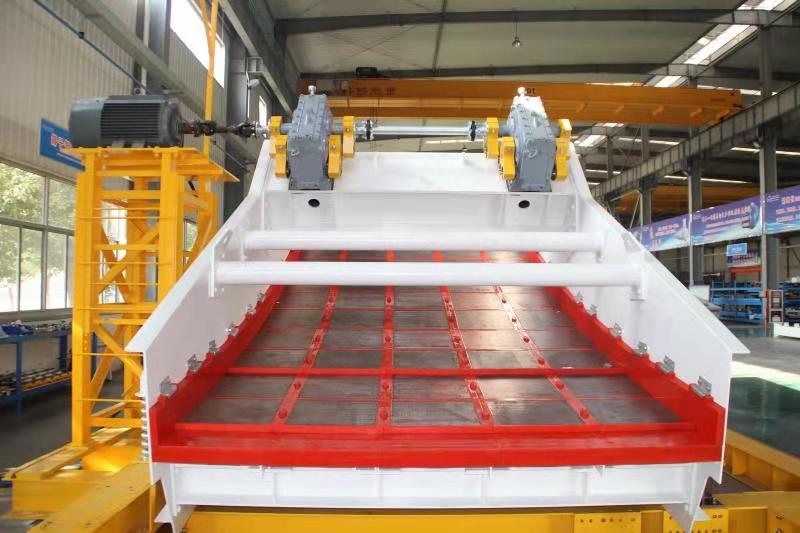
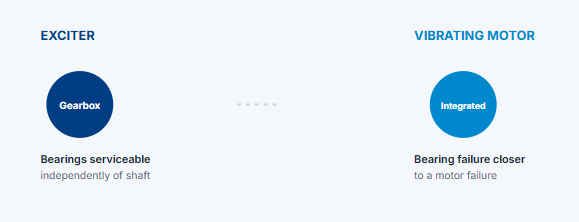
Exciters or Vibrating Motors? Drive Selection and Service Life for Screens A vibrating screen’s performance gets attributed almost entirely to deck geometry and media banana versus horizontal versus inclined, wire versus polyurethane versus rubber, and both of those decisions matter. But neither one delivers anything if the drive underneath the deck can’t produce the motion those decisions assume it will. The exciter or vibrating motor is the part of the specification that gets the least attention and causes some of the most misdiagnosed performance problems. It’s also the component most often treated as interchangeable once tonnage and screen size are settled, when in practice the drive choice interacts directly with both the geometry decision and the deck media decision already covered in this series. Exciter or Vibrating Motor: The Actual Difference An exciter is a gearbox-style unit built around contra-rotating eccentric shafts, generating linear or circular motion depending on configuration, typically driven through a standard motor via belt or direct coupling. The eccentric shafts and their bearings are serviceable independently of the drive motor; a bearing rebuild doesn’t necessarily mean replacing the whole unit. A vibrating motor integrates the eccentric weights directly onto the motor shaft itself, combining the drive and the vibration source into a single unit. It’s mechanically simpler, with fewer total parts, and typically more compact for a given duty, but that same integration means a bearing failure inside the unit is closer to a motor failure than a component rebuild. Why the Choice Matters for Your Duty Exciters generally handle higher G-forces and heavier screen structures, which is part of why they’re the more common choice on larger, higher-tonnage screens the same screens where the banana geometry’s compound slope demands consistent stroke and amplitude delivery across a deck that isn’t a single flat plane. Specifying an undersized exciter for that duty leads to the same issues we’ve described before: reduced capacity or poor screening efficiency, which can be misdiagnosed as a deck media problem when the drive fails to deliver the motion profile the geometry was designed around. Vibrating motors earn their place on smaller or lighter-duty screens, where the lower parts count and more compact footprint are a genuine advantage and the duty doesn’t demand the higher G-force range exciters are built for. The trade-off is in how the two technologies fail, not just in how they run. Neither option is inherently the better choice; the mistake is picking based on what’s already stocked in the maintenance store or what a previous specification happened to use, rather than the actual G-force and duty class the screen needs. A vibrating motor undersized for a duty that genuinely needed an exciter will show the same symptoms as a media problem: reduced throughput and poor separation that no amount of aperture adjustment will fix. Service Life: What Actually Determines It Bearing life is the dominant wear factor for both technologies, but the consequence of that wear differs in a way that matters more than the purchase price comparison most specifications focus on. An exciter’s bearings can typically be rebuilt in a workshop while the housing and shafts continue in service, which keeps the total cost of a bearing failure closer to a component repair than a capital replacement. A vibrating motor’s integrated design means a bearing failure is closer to a motor failure; repair options exist, but the unit is more likely to be exchanged or replaced outright than rebuilt in place. This isn’t a reason to avoid vibrating motors on the duty they’re suited to; it’s a reason to price the comparison on total cost of ownership across a few bearing cycles, not on the upfront unit cost alone. Matching the Drive to the Geometry, Not Just the Tonnage Screen geometry and drive sizing need to be specified together, not sequentially. A horizontal screen depends entirely on the exciter or motor to generate conveying motion, since gravity isn’t contributing at near-zero slope, which typically means running at a higher G-force than an equivalent inclined design needs for the same throughput. A banana screen’s compound slope means the drive has to deliver consistent stroke and amplitude across a deck that changes angle along its length, a different mechanical demand than driving a constant-angle deck evenly. What to Check If Performance Has Drifted Before assuming a deck media or geometry problem, check the drive itself. Bearing condition and amplitude drift both reduce effective motion gradually, often before either shows up as an obvious fault. Confirm the actual stroke and G-force against the design specification rather than assuming a drive recently in service is still delivering its rated output, and check eccentric weight settings haven’t shifted from their commissioned position; a small change here changes the motion profile the whole screen depends on. This diagnostic sequence matters because the two failure modes look identical from the control room. A screen losing capacity due to a worn or under-driven exciter and a screen losing capacity due to blinding deck media both show up as the same drop in throughput and product quality. Checking the drive first, before assuming the more visible deck media is at fault, avoids replacing media that was never the actual problem. How John Finlay Helps Our Exciters are specified alongside our Vibrating Screens as a matched pair, sized to the specific deck geometry and duty rather than sold as a generic drive component. If your screen’s performance has drifted and the deck media looks fine on inspection, the drive is worth checking before anything else. Our engineers can confirm whether your current exciter or vibrating motor is actually still delivering the motion your screen was designed around. Not sure if your drive is still delivering rated motion? Our engineers can confirm whether your current exciter or vibrating motor matches your screen’s design. Talk to an Expert Related Equipment Banana, Horizontal or Inclined? Screen Selection Deck geometry decisions that depend on correct drive sizing. Screen Blinding & Deck Media Selection The other half of the diagnosis is
Exciters or Vibrating Motors? Drive Selection and Service Life for Screens Read More »