Lead-Zinc Ore Sorting at Fankou Mineral Processing Plant
Every lead-zinc mine generates waste rock, material pulled from the ground that never carried quite enough metal to be worth processing. Normally, it goes on a pile, and it stays there. At Zhongjin Lingnan Nonfemet Co., Ltd.'s Fankou operation, that pile became the feedstock for a different kind of plant.
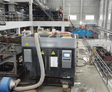
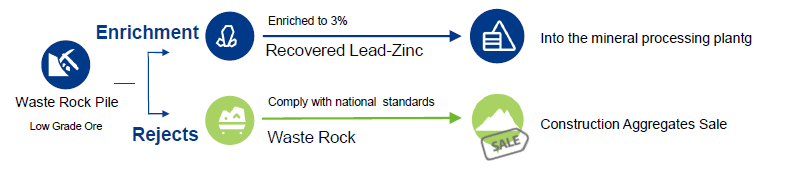
Rather than treat old waste rock and low-grade ore as dead weight, Zhongjin Lingnan installed sensor-based ore sorters to run, John Finlay Group’s sister company in China, to run that material back through a +10–50mm sorting circuit. What comes out the other side splits two ways: a lead-zinc-enriched stream that goes on to the mineral processing plant and a rejected stream clean enough, by national standards, to be sold directly as construction aggregate. Very little goes back to the waste pile.
From Waste Pile to Two Revenue Streams
The sorting circuit processes a +10–50mm fraction at combined raw grades of 1.11% Pb and 1.25% Zn, low by ore standards, which is exactly why this material had been stockpiled rather than processed in the first place. The sorters reject more than 90% of that feed, but what they keep is transformed: concentrate grade comes out at 10.74% Pb and 11.6% Zn, an enrichment of roughly 9.7× for lead and 9.3× for zinc.
The rejected 90%+ isn’t waste in the usual sense. It meets national construction material standards and is sold directly as aggregate, giving the mine a second product line from material that would otherwise sit in a stockpile indefinitely.
Where the $9.21 Million Comes From
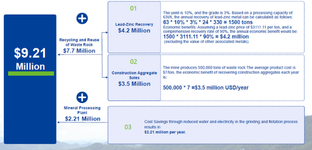
The economics break down into three pieces. Recovering lead-zinc metal from the enriched stream, based on a 63 t/h processing rate, a 10% yield, and a 3% grade, set against a lead-zinc price of roughly $3,111 per tonne and a 90% comprehensive recovery rate, is worth an estimated $4.2 million a year. Selling the rejected material as construction aggregate, at roughly 500,000 tonnes a year and $7 a tonne, adds another $3.5 million. Together, that’s $7.7 million recovered from material that used to just be a waste pile.
On top of that, sorting ahead of the grinding and flotation circuit cuts water and electricity use enough to save a further $2.21 million a year in the mineral processing plant itself. John Finlay puts the combined annual benefit at $9.21 million.
Sorting Results
● Raw Ore Grade: 1.11% Pb, 1.25% Zn
● Concentrate Grade: 10.74% Pb, 11.6% Zn
● Waste Rock Grade: 0.04% Pb, 0.10% Zn
● Rejection Rate: >90%
● Enrichment Ratio: 9.68× Pb, 9.28× ZnA Verified Result
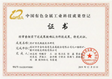
This wasn’t just an internal estimate. The approach and its results were formally registered as a science and technology achievement with China’s nonferrous metals industry authority, a documented sign-off on both the technique and the numbers behind it.
Conclusion
Fankou’s construction materials plant is a good example of what pre-concentration can do beyond the mine face: it turns an old waste rock pile into two saleable products, cuts operating costs in the plant it feeds, and does it on material that had already been written off once.