
Product Moisture in Coal Washeries: What Actually Drives It
Ash and yield get negotiated in the sale contract. Product moisture gets measured on every truck, every time, with no negotiation involved. It’s the one quality parameter a washery can’t argue about after the fact, which is exactly why it’s worth understanding what actually drives it instead of treating it as whatever the dewatering circuit happens to produce.
It’s also the parameter most likely to get misdiagnosed, because a moisture complaint arrives as a single number with no indication of which of several possible causes produced it. Feed characteristics, equipment match, equipment condition, and post-dewatering handling can all move the same figure, and they call for completely different fixes.
22%
Feed moisture (avg)
15%
Product moisture (avg)
4
Variables that actually drive it
8hr
Sustained test run, no drift
Feed Characteristics Set the Floor
Particle size distribution is the starting point, and it puts a floor under product moisture before any piece of equipment does anything. Finer particles carry proportionally more surface area per tonne, and surface moisture scales with that surface area. A feed with a heavier fines fraction will always retain more moisture than a coarser one, at the same dewatering performance. This phenomenon is why comparing product moisture across two plants running different coal sources without accounting for particle size is close to meaningless.
Near-size and ultra-fine material makes this worse specifically because the finest fractions are the hardest for any dewatering technology to release water from. The same fines that create screening and classification challenges elsewhere in the circuit tend to be the fraction driving your moisture number higher than the coarser bulk of the product.
Equipment Technology Has to Match the Stream
Once feed characteristics are accounted for, the next variable is whether the dewatering technology is actually matched to the stream it’s handling. We’ve covered this in detail separately: a centrifuge fed material finer than it’s sized for loses retention efficiency and passes fines through the screen instead of dewatering them, while a filter press fed a stream that’s too coarse or too dilute cycles inefficiently without necessarily showing up as an obvious fault.
The practical implication for product moisture specifically is that a mismatch between technology and stream often looks like a moisture problem when it’s actually a specification problem; the equipment isn’t failing, it was never matched to the material it’s running.
Equipment Condition and Setpoints
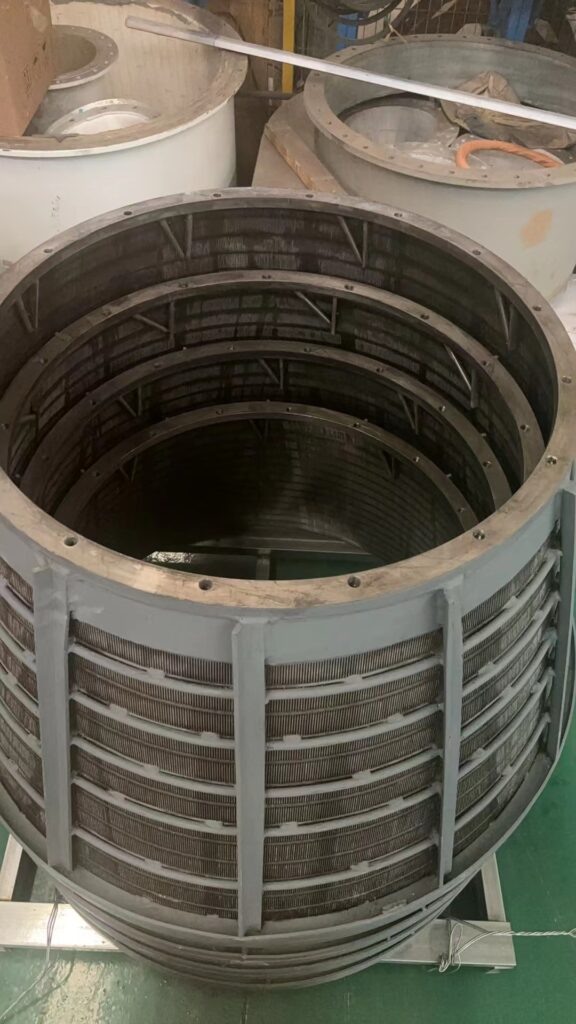
Assuming the technology itself is correctly matched, condition and setpoints are where most of the remaining variation comes from. Basket screen wear on a centrifuge aperture worn open beyond spec reduces retention before the wear is visually obvious, and a machine running below its designed basket speed dewaters worse regardless of how well the basket was originally specified. We go into basket type, capacity and wear life in more depth in our post on centrifuge selection.
Deck media condition on upstream screens plays a role too, even though screening and dewatering are usually thought of as separate process steps. A screen that’s blinding or carrying excess near-size material into the dewatering stage is effectively handing the dewatering equipment a harder feed than it was designed around, and no amount of centrifuge or filter press tuning fully compensates for a feed problem created a step earlier in the circuit.
What Happens After Dewatering Matters Too
This stage is the factor most often left out of a moisture diagnosis entirely. Product moisture measured at the point of dewatering and product moisture measured at the point of dispatch are not always the same number, and the gap between them is usually rehydration rain exposure on an open stockpile, humidity absorption during extended storage, or handling practices that reintroduce surface water after the dewatering equipment already did its job correctly.
A plant chasing a moisture complaint at the dewatering stage when the actual cause is stockpile exposure will tune equipment that was never the problem, while the real cause sits untouched in the yard. Checking where in the chain moisture is actually being added at dewatering or after is worth doing before assuming which piece of equipment to investigate.
What Real Performance Looks Like
We’ve published real test data from a basket centrifuge before: an eight-hour run on combined clean and middling coal held feed moisture at 22% and product moisture at 15%, a consistent 7 to 8 percentage point reduction sustained across the full shift, with no drift as the run continued. That consistency across a full run, not a single favorable reading, is what separates dewatering equipment that’s actually performing from equipment that’s producing a good number under ideal, short-duration conditions.
Diagnosing Your Own Moisture Number
Start with the distribution of feed particle sizes before assuming an equipment problem, since a shift toward finer feed can raise product moisture with every piece of equipment performing exactly as designed. Confirm the dewatering technology is actually matched to the stream’s particle size and solids concentration, not just installed because it was available. Check the basket screen or filter cloth condition against spec rather than assuming equipment recently in service is automatically performing to its original rating. And separate moisture measured at dewatering from moisture measured at dispatch, because there is a gap between the two points to storage and handling, not the dewatering circuit itself.
Work through these in that order rather than starting with whichever machine is easiest to inspect. A centrifuge is usually the first thing checked when moisture drifts, simply because it’s the visible, mechanical piece of the chain. But if the actual cause is a change in the coal source upstream or rain on an open stockpile downstream, time spent tuning the centrifuge is time not spent on the cause that is actually moving the number.
How John Finlay Helps
Product moisture is rarely one variable acting alone; it’s usually feed characteristics, technology match, and equipment condition compounding together, which is why we look at the whole dewatering circuit rather than a single machine in isolation. We supply and commission Centrifuges and Filter Press Machines matched to your actual feed, and our engineers can help trace a moisture number back to whichever stage in the chain is actually driving it, including checking whether the real cause sits downstream of dewatering entirely.
Not sure what's driving your moisture number?
Our engineers can help trace it back to feed, equipment, or post-dewatering handling.
Talk to an ExpertRelated Equipment
Tailings Dewatering: Filter Press, Belt Press or Centrifuge?
Choosing the right dewatering technology for your stream.
Centrifuge Selection: Basket Type, Capacity and Wear Life
Basket type, capacity, and wear life for coal dewatering.